

We get the same call every few weeks. A business owner has bought three or four AI tools over the past year. There is an AI writing tool for marketing, a chatbot bolted onto the website, a transcription service somebody signed up for, and a knowledge base that was set up once and never touched again. The subscriptions total a few thousand ringgit a month. Nothing measurable has changed.
The instinct is to blame the tools. In almost every case we look at, the tools are fine. What is missing is underneath them.
Here is the uncomfortable pattern. A company spends the money, installs the software, and six months later the tools have been upgraded while the way people actually work has not moved at all. What was disorganised before is still disorganised. What was slow before is still slow. The invoices simply got bigger.
This article is about why that happens, and what to sort out before you spend anything else.
What AI tools are genuinely good at
It is worth being fair to the technology first, because the capability is real.
Modern AI handles the repetitive middle of a job extremely well. It drafts a first version of a reply. It reads a long document and pulls out what matters. It classifies an enquiry, tags it, and routes it. It turns a rough voice note into a structured summary. Given clean input and a clear instruction, it does these things faster and more consistently than a person having a bad afternoon.
That capability is not in dispute, and it is why the sales demos are so convincing. In a demo the process is perfect. There is one clean enquiry, one obvious next step, and one person handling it.
Your business is not a demo. The gap between the two is where the money disappears.
Mistake one: buying a tool for every gap
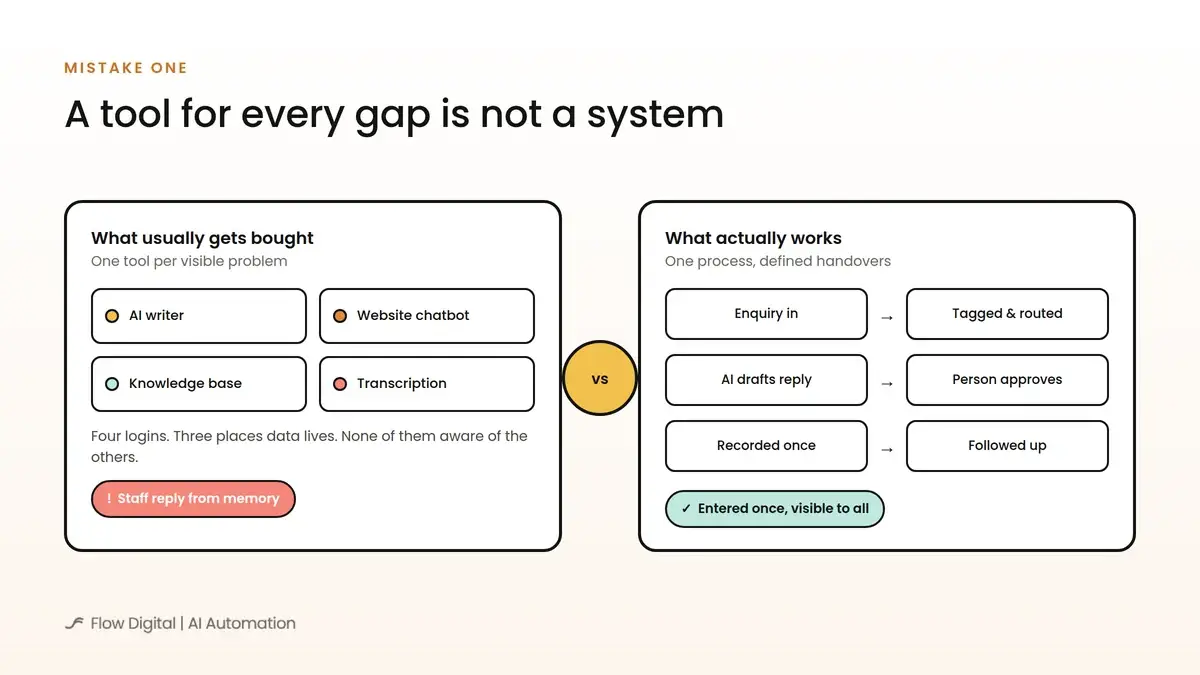
The most common pattern we see is a tool bought for each visible problem.
Marketing is short of copy, so somebody buys an AI writer. Sales is not following up reliably, so a chatbot gets added. Knowledge keeps walking out of the door with departing staff, so a knowledge base goes live. Each purchase is defensible on its own. Together they create a fourth problem nobody planned for.
Now there are four logins, four places where information lives, and four tools that do not know about each other. The chatbot cannot see what sales promised last week. The knowledge base does not know what marketing published yesterday. A staff member who wants to answer a customer properly has to check three systems, so in practice they check none of them and reply from memory, exactly as before.
More tools do not compound. Disconnected tools compete for the same fifteen minutes of your team’s attention, and lose to the habit that was already there.
Mistake two: the process was never written down
Ask most SME owners how a customer enquiry travels through their business and you will get a confident answer. Ask two staff members the same question separately and you will usually get two different ones.
That is not a criticism of anyone. Small businesses run on people who know what to do. The knowledge lives in the heads of the three or four people who have been there longest, and it works, right up until you try to hand part of it to software.
A tool cannot absorb a process that exists only as shared instinct. It needs to know what happens first, what happens next, what the exceptions are, and what finished looks like. If nobody has ever written that down, the tool will invent its own version, and its version will be whatever was most common in its training data rather than whatever is true in your shop.
This is the single biggest predictor we have found of whether an automation project works. Not the budget, not the platform, not the technical skill of the team. Whether the process existed in writing before the tool arrived.
Mistake three: nobody owns the handover point
Take the most concrete example we deal with, which is sales follow-up.
AI screens your incoming enquiries and identifies the ones worth chasing. Genuinely useful. And then what?
Who follows up, and how quickly? How often do they chase before giving up? What did the customer actually ask for, and where is that recorded so the next person can see it? How do you nurture a high-intent lead differently from a low-intent one? When the enquiry goes quiet for three weeks and then returns, who notices?
If the answers to those questions are vague, the AI has simply produced a faster supply of leads into a process that was already leaking. You have not fixed the bottleneck. You have increased the pressure on it.
We have watched this play out more than once. The tool works exactly as advertised, response times get worse, and everyone concludes that AI does not work for their industry.
Mistake four: no one agreed what success would look like
Very few of the stalled projects we are asked to rescue had a number attached at the start.
Without one, the conversation six months later becomes a matter of opinion. The owner feels nothing has changed. The manager who championed the tool feels it has helped. Neither can prove it, so the subscription quietly continues and nobody wants to admit the spend was wasted.
A target does not need to be sophisticated. Average first response time under thirty minutes during business hours. Quotations issued the same day instead of the next. Two hours per week returned to the person who currently retypes orders by hand. Any of these can be measured before you start and measured again afterwards.
If a tool cannot be tied to a number like that, it is worth asking honestly what it is for.
Mistake five: the people doing the work were told, not asked
The staff who handle the process every day know exactly where it breaks. They know which step is duplicated, which form nobody fills in properly, and which customer type always causes trouble.
When a tool is chosen above them and handed down, two things happen. The design misses the real friction, because the friction was never described to anyone. And the people expected to change their habits have no reason to. They were not consulted, they did not ask for it, and the old way still works well enough to get through today.
Adoption is not a training problem. It is a design problem that shows up at training time.
What good AI automation actually looks like
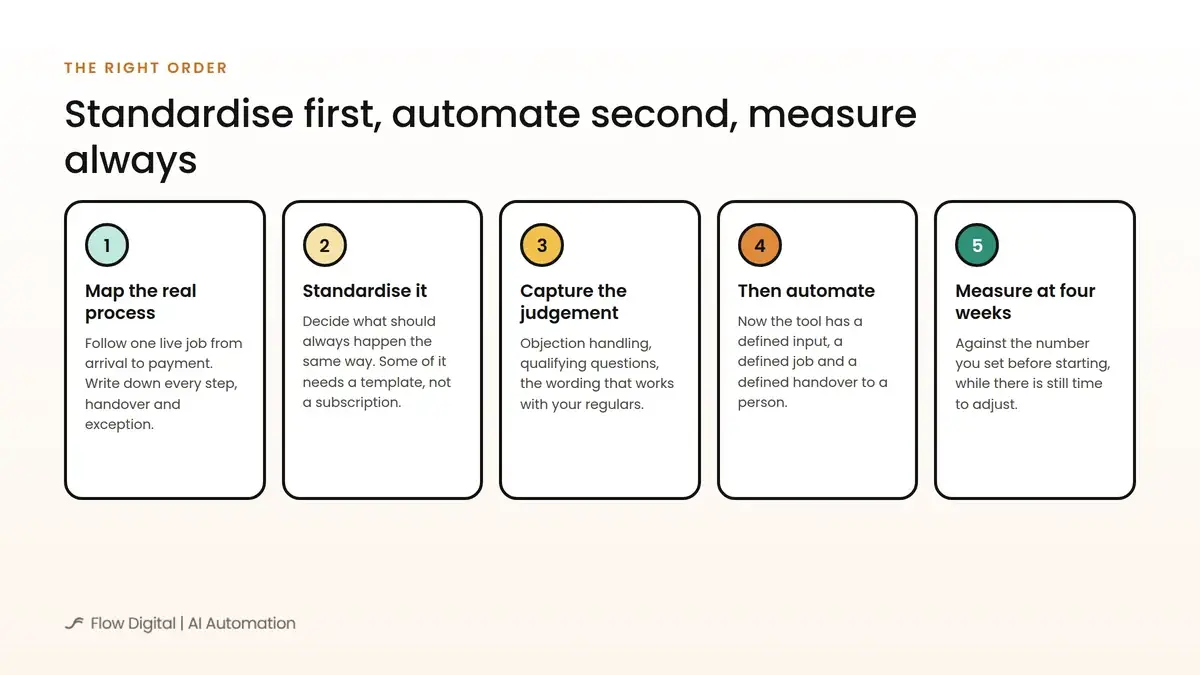
The order matters more than the tooling. This is the sequence we use.
1. Map how the work actually runs today. Not how it is supposed to run. Sit with the people doing it and follow one real enquiry from arrival to payment, writing down every step, handover and exception. This usually takes half a day and is frequently the most valuable half day of the project, because it is where the duplicated steps become visible.
2. Standardise before you automate. Decide which steps should always happen the same way, and write them down in plain language. Some of what you find at this stage does not need AI at all. A shared template, a required field, or a single agreed place to record enquiries often removes more friction than any subscription.
3. Capture the judgement worth keeping. The way your best salesperson handles a price objection, the questions your senior technician asks before quoting, the wording that works with your regulars. This is the material that turns a generic tool into something that sounds like your business.
4. Then let AI take the repetitive, fiddly, time-consuming parts. Now the tool has a defined job, a defined input, and a defined handover to a person. It has somewhere to land.
5. Measure against the number you set. Check at four weeks, not at twelve months, while there is still time to adjust.
Standardise or automate: how to tell which you need
If a task is done differently by different people, standardise it first. If a task is already consistent but simply slow or repetitive, it is a genuine automation candidate. If a task requires judgement that changes with each customer, keep a person in it and use AI to prepare the information they need rather than to make the decision.
Most SMEs we work with find that roughly half of what they hoped to automate belongs in the first category. That is not a failure. It is the cheapest finding in the whole project.
What this means for Malaysian SMEs
Some realistic expectations, based on what we see in this market.
A process mapping and standardisation exercise for one workflow, such as enquiry to quotation, typically takes one to two weeks and lands between RM3,000 and RM8,000. It produces documented processes you own whether or not you ever buy a tool.
A focused automation build on top of that, connecting two or three systems with defined handovers, usually runs RM8,000 to RM30,000 depending on how many integrations are involved and how clean the existing data is.
Ongoing tooling is the smaller number and the one everybody fixates on. Most SME stacks we see sit between RM200 and RM1,500 per month, which is frequently less than the value of the staff time being lost to the unstandardised process.
The warning sign is a quote that covers only the tool and the setup, with nothing for process work. That is the shape of a project that will be technically delivered and practically unused.
Start with one workflow, not five. Pick the one where mistakes cost you the most, usually anything touching orders, stock or quotations. Get it working end to end, prove the number moved, and then move to the next one.
Frequently asked questions
Why do most AI tools fail in small businesses?
Because the process underneath them was never standardised. The tool needs a defined input, a defined job and a defined handover to a person. When the process lives only in the heads of long-serving staff, the tool invents its own version and creates inconsistency rather than removing it.
Should I fix my process before buying AI tools?
Yes, and it usually costs less than the tools do. Mapping and standardising one workflow takes days rather than months, and it frequently removes enough friction on its own that the eventual automation is smaller and cheaper than originally planned.
How much does business process automation cost in Malaysia?
Process mapping and standardisation for a single workflow typically runs RM3,000 to RM8,000. A focused automation build on top usually falls between RM8,000 and RM30,000 depending on integrations and data quality. Monthly tooling for most SMEs sits between RM200 and RM1,500.
How long before automation shows a return?
Set a measurable target before you start and check it at four weeks. A well-scoped single-workflow project should show a movement in response time, turnaround time or hours recovered within the first month. If nothing has moved by then, the problem is the design rather than the timeline.
Which processes should a Malaysian SME automate first?
Start where errors are most expensive, which is usually anything touching orders, stock or quotations. Those processes are repetitive, high volume, and the cost of getting them wrong is visible immediately, which makes the improvement easy to prove.
Do I need an ERP before automating anything?
No. Plenty of useful automation sits on top of the systems you already run. That said, if your data lives across spreadsheets and disconnected apps, a platform such as Odoo ERP can be the cheaper long-term answer than integrating six tools that were never designed to talk to each other.
Will my staff actually use it?
They will if they helped design it. Adoption problems are nearly always design problems that surface at training time. Involve the people doing the work during the mapping stage and they will tell you where the real friction is, which makes the tool better and the rollout easier.
How is Flow Digital different from a software vendor?
A vendor sells you the tool. We start by mapping and standardising the process, and we will tell you when the answer is a template and a rule rather than a subscription. The automation comes after the process is sound, which is the part that decides whether any of it gets used.
Sort the process, then automate it
Flow Digital builds AI automation and internal business systems for Malaysian SMEs. We use AI across everything we deliver, which is exactly why we are careful about what it should and should not be handed.
If any of the mistakes above sound familiar, these are the pieces we handle:
- Process mapping and SOP documentation: following one real job from arrival to payment and writing down what actually happens, including the exceptions
- Standardisation before tooling: deciding what should always happen the same way, and fixing what a template or a required field can fix without a subscription
- Capturing the judgement worth keeping: the objection handling, the qualifying questions and the wording that make your business sound like itself
- Workflow automation and integration: connecting WhatsApp, e-commerce, accounting and reporting with defined handovers, so data is entered once
- Measurement: agreeing the number before we start and checking it at four weeks, while there is still time to adjust
Find out more at flowdigital.my, or message us and we will walk through one workflow with you.
Get in touch
WhatsApp: +6010 886 1055
Email: [email protected]