

A laptop arrives with a supplier bill, then gets handed to an employee. At month-end, finance may see only an expense entry, while operations knows who uses it but cannot point to a tag or register record. We see this gap when the purchase, ownership record and accounting workflow have been designed separately.
An asset management tracking system closes that gap by connecting an approved purchase to an asset record, a custodian, an identifier and a review process. Software helps, but the outcome is a controlled fixed-asset workflow: people can find the item, finance can support its treatment, and management can see what the business owns.
What already works: an ERP can connect purchases, asset records and scheduled depreciation
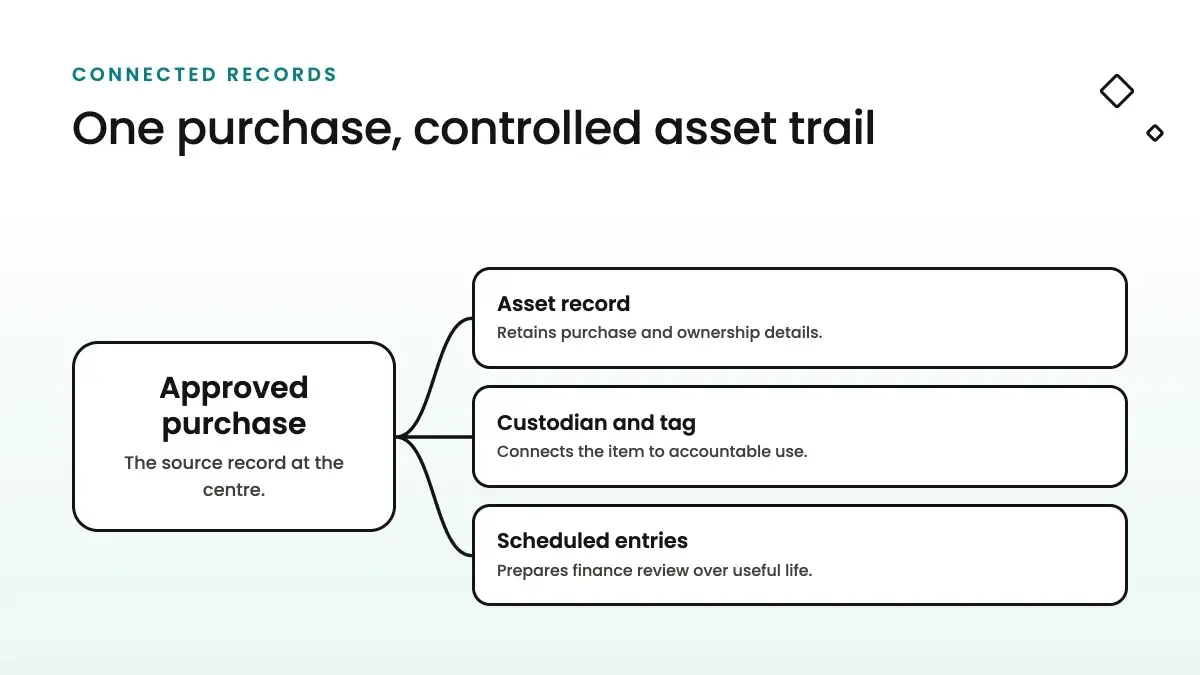
ERP platforms are genuinely useful here. When the chart of accounts and workflow are deliberately mapped, a bill coded to a fixed-asset category can create an asset record, retain the purchase link and prepare scheduled accounting entries. The exact behaviour depends on the selected platform, enabled modules and deployment configuration, so we test it before relying on it.
- Connected purchase trail: Automated asset management software can connect a supplier bill, approval and asset record instead of leaving finance to rekey details into a separate spreadsheet. This only works when buyers and accounts staff use the correct category and exception route.
- Planned accounting entries: An approved asset model can prepare a schedule of planned accounting entries over an asset’s useful life. Finance should review the dates, values and postings rather than treating the schedule as an unquestioned default.
- Shared visibility: A register can show acquisition details, custodian, tag and status alongside finance information. That gives operations and finance one controlled record, while each team sees the fields relevant to its role.
Build the fixed-asset tracking system around an approved policy
A fixed asset tracking system starts with an approved policy, not a software screen. The policy defines which purchases are capitalised, meaning recorded as long-term business assets, and which are treated as ordinary expenses. Finance and the business’s accountant should approve the decisions before configuration.
- Register fields: Your fixed asset register should capture a unique asset ID, description, category, acquisition date, supplier document, purchase value, location, custodian, tag number and current status. It should also retain links to approvals, transfer records and disposal support.
- Thresholds and categories: Set a documented capitalisation threshold and categories that reflect how management reports assets, such as IT equipment, furniture, vehicles or specialist machinery. Repairs and low-value purchases need a clear exception path so they do not create unnecessary asset records.
- Accountability rules: Name the custodian responsible for day-to-day possession and an approver for category, useful life and residual-value choices. A residual value is the amount expected to remain outside the scheduled calculation, and it should be an approved policy choice, not an estimate entered casually.
Choose the records, tags and tools that make each asset traceable
The right identification method depends on how often assets move, how many need checking and whether staff need a location history. Not every item needs real-time tracking. For many SMEs, a label plus periodic verification is more useful and proportionate than a complex sensor network. These asset management tools should support the verification process your team can maintain.
- Barcode and QR labels: A barcode asset tracking system works well for controlled checks with a scanner or phone, while qr code asset tracking software is convenient where staff use a camera. Barcode asset tracking and QR scans both suit assets that are verified periodically, provided labels are durable and users update transfers promptly.
- RFID for faster counts: An rfid asset tracking system uses radio-frequency labels that can support rapid bulk verification without individually aiming a camera at every tag. It is valuable where large volumes make manual scanning slow, but tags, readers and process design must justify the additional cost.
- BLE for moving or location-sensitive assets: A ble asset tracking system uses Bluetooth Low Energy signals and can help identify the last known proximity of selected equipment. These asset tracking devices need coverage planning, battery management and realistic expectations, because BLE is not a guarantee of precise live location in every environment.
- Mobile verification: A mobile asset tracking app allows authorised staff to scan, confirm a custodian, record a transfer and attach evidence during a stocktake. Mobile asset tracking improves timeliness when the app is tied to roles, an approval workflow and a central register.

Configure depreciation rules and ledger mapping with finance
Depreciation accounting software can schedule entries, but it cannot decide the policy for you. Keep this part practical: finance agrees the approach, timing and supporting accounts, then the implementation team configures and tests the resulting entries.
Map each category to the relevant fixed-asset account, accumulated-depreciation account and depreciation-expense account. Record the acquisition date, approved method, useful life, posting frequency and residual value for each category or asset. Finance and the company’s accountant must choose and approve these settings, then review test purchases, journal impact and reporting output before go-live.
Make purchase bills create traceable asset records
The most reliable control is to make the purchase process create the asset trail at the point it enters finance. A bill link alone is not enough: the record needs the right coding, tag assignment and validation before it becomes part of the live register.
- Code bills correctly: Set guided bill coding so approved capital purchases go to the relevant fixed-asset category rather than a general expense account. Automated asset management software can then create or trigger a draft asset record, subject to the platform’s tested configuration.
- Validate and tag: Before posting or activating the record, confirm the supplier document, approval, category, acquisition date, value and custodian. Assign a barcode, QR, RFID or BLE identifier at receipt where practical, then keep a clear record if tagging must happen later.
- Handle exceptions deliberately: Define routes for repairs, bundled purchases, low-value items, partial deliveries and capital expenditure awaiting approval. During migration, clean duplicate records, missing custodians and opening values before loading pre-go-live assets.
Keep accounting depreciation separate from Malaysian tax treatment
Accounting depreciation in the register and Malaysian tax capital allowances have different purposes. The first supports financial reporting and management control; the second belongs in the tax computation. Asset depreciation Malaysia workflows should preserve enough documentation for reconciliation without assuming that one schedule replaces the other.
Use the register and general ledger for the approved accounting workflow, then work with the company’s accountant or tax adviser on tax treatment. Keep the bill, approval, category rationale, date in use, tag record and disposal documentation linked to the asset, and escalate sales, theft, write-offs and transfers promptly.
What good looks like: a seven-step asset-tracking implementation
A successful implementation does not start by importing a spreadsheet into a new platform. It progresses through policy, data, tags, configuration and tested handover, with sign-off from the people who will use and review the process.
- Clean the current register: Remove duplicates, identify missing fields and separate active assets from disposed or unknown items. This establishes a credible opening population.
- Approve policy and categories: Agree thresholds, categories, owners, approval roles and accounting choices with finance and the accountant. Put the decisions into a usable policy and category template.
- Map accounts and workflows: Configure category-level ledger mapping, bill coding, validations and exception routes. Define who can create, approve, transfer and dispose of records.
- Select the tagging approach: Choose barcode, QR, RFID or BLE based on movement, verification frequency and budget. Trial labels and scanning conditions before committing to a large rollout.
- Migrate and tag opening assets: Load cleaned records with supporting values and ownership details, then tag live assets in a controlled verification exercise. Record exceptions for assets that cannot be found or confirmed.
- Test end-to-end scenarios: Test purchase-to-asset creation, scheduled entries, transfers, disposals and reporting against expected ledger outcomes. Include exceptions, not only the ideal path.
- Train and sign off: Train custodians, purchasing staff and finance users, then complete a reconciliation before go-live approval. Require documented, tested sign-off before the workflow becomes business as usual.

When an SME needs ERP-based asset tracking rather than a spreadsheet
A spreadsheet remains sensible for a small, stable register with a single responsible user and infrequent manual verification. It becomes fragile when multiple people change ownership, purchases must link to bills, or finance needs repeatable approval and reconciliation controls.
- Use a spreadsheet when it remains controlled: A simple register can work where asset volumes are low, locations are limited and checks happen consistently. Protect formulas, set one record owner and retain supporting documents outside the sheet.
- Move to shared workflow controls when needed: Enterprise asset tracking software is appropriate when multiple users require roles, approvals, purchase links, scan-based verification and reporting. Cloud-based asset tracking software gives authorised teams access to one current record without passing files between users.
- Assess the wider process: Cloud asset management software may sit within an ERP where procurement, finance and operational records need to connect. Inventory and asset tracking software should still distinguish items held for sale from long-lived assets, because their controls and accounting treatment are different.
Malaysia rollout: scope, budget inputs and implementation timeline
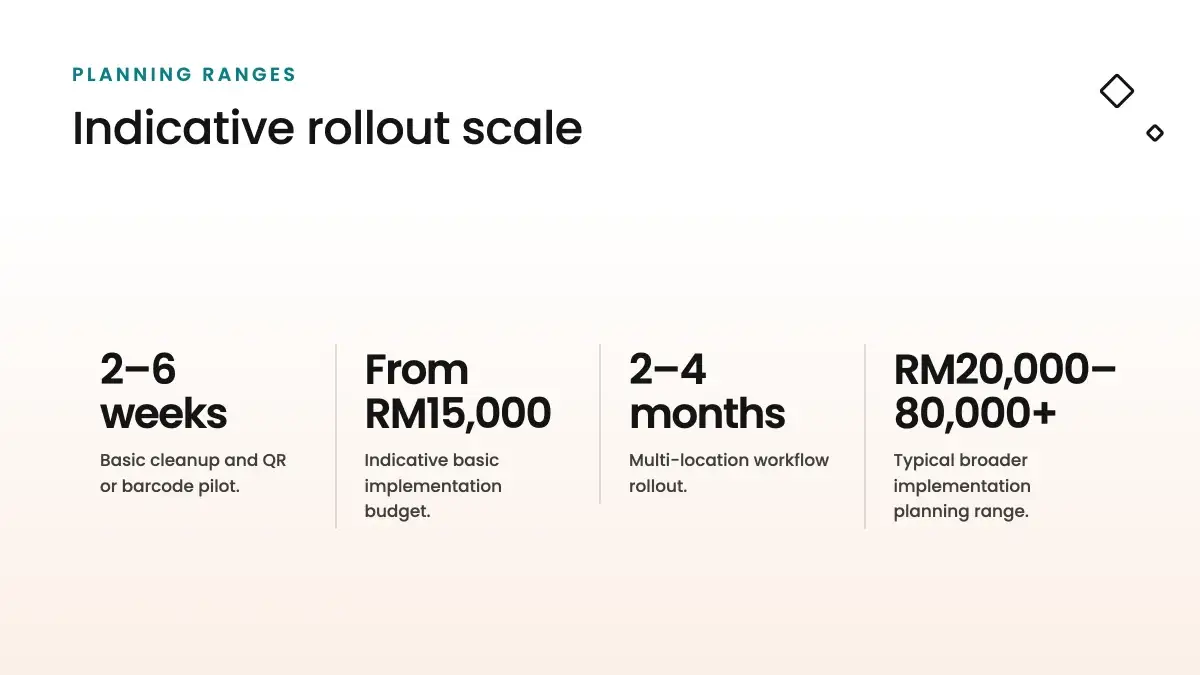
For asset management tracking system Malaysia projects, our planning ranges reflect implementation work rather than a universal software price. Final scope depends on the quality of the existing register, number of locations, user roles, hardware, integrations and migration volume.
- Basic setup: Register cleanup, categories and a QR or barcode pilot commonly take two to six weeks and need an indicative implementation budget from RM15,000. This suits a defined asset population and limited workflow complexity.
- Broader workflow rollout: A multi-location ERP workflow with migration, mobile scanning, RFID or integrations commonly takes two to four months and often requires RM20,000 to RM80,000+. The range grows when records need extensive verification or processes require custom approvals.
- Evaluate total asset tracking software pricing: Include implementation, labels or readers, user training, migration, support and any future integration work in the decision. A low licence cost does not compensate for an unclean register or an untested finance workflow.
Ready to make every fixed asset easier to find and account for?
Flow Digital builds ERP asset-tracking workflows for SME owners in Malaysia. We work alongside your accountant to turn your policy, records and finance controls into a tested operational process.
If purchase records, tags and finance schedules do not yet join up, these are the pieces we handle:
- ERP purchase and asset workflow: We map bill coding, approvals and traceable asset-record creation.
- Fixed-asset policy and register design: We structure categories, fields, owners and migration requirements around your controls.
- Tagging and mobile verification: We assess QR, barcode, RFID and BLE options against how your assets move.
- Finance configuration and testing: We configure approved mappings and test accounting scenarios with your finance team.
- Implementation rollout: We support data cleanup, training, sign-off and a practical go-live plan.
- ERP selection and scope: We identify when a spreadsheet is enough and when connected workflow controls are needed.
- Malaysia rollout planning: We define scope, hardware, migration and budget inputs before delivery.
Find out more at flowdigital.my, or message us and we’ll walk through your asset-tracking setup with you.
Get in touch
WhatsApp: +60108861055
Email: [email protected]
Start a WhatsApp conversation →
Frequently Asked Questions
What is an asset management tracking system?
An asset management tracking system is a controlled way to record, identify, assign and review business assets. It connects records such as purchase documents, tags, custodians, locations and status changes. In a finance workflow, it can also support an asset register and scheduled accounting entries.
What should a fixed asset register include?
A fixed asset register should include a unique ID, description, category, acquisition details, value, custodian, location, tag and current status. It should link to approvals and source documents, as well as transfers and disposal records. Finance should agree the accounting fields with the company’s accountant.
Should we use barcode, QR code, RFID or BLE asset tracking?
The best option depends on asset movement and verification needs. Barcode and QR labels suit periodic checks, RFID can speed bulk counts, and BLE can assist with proximity tracking for selected mobile equipment. Start with the simplest method that provides reliable evidence and can be maintained by users.
Can asset tracking software automate depreciation entries?
Yes, suitably configured software can prepare and post scheduled accounting entries. The category, accounts, acquisition date, method and posting frequency must be approved and tested first. Finance should review the planned entries and reconcile postings as part of its normal controls.
What is the difference between accounting depreciation and Malaysian tax capital allowances?
Accounting depreciation supports financial reporting, while tax capital allowances support tax computation. They should not be assumed to use the same basis or schedule. Your accountant or tax adviser should review tax treatment and reconciliations.
How much does asset tracking software cost in Malaysia?
Implementation for a basic register cleanup and QR or barcode pilot commonly starts from RM15,000. Broader ERP workflows often require RM20,000 to RM80,000+. These are our indicative implementation planning ranges, not fixed software prices, and hardware, data quality, migration and integration needs materially affect cost.
What is the best asset tracking software for a Malaysian business?
The best asset tracking software for business is the one that fits your asset volume, controls and finance workflow. A spreadsheet can suit a small, stable register, while a cloud ERP workflow suits teams needing approvals, bill links, mobile scans and reconciliation. Assess the process and data before selecting a platform.
Can I use a mobile app to track company assets?
Yes, a mobile app can support scanning, custodian confirmation, transfers and verification evidence. It works best when it connects to the central register and assigns actions to authorised users. Train staff on when to update records so the app does not create a second, inconsistent data set.
How is [Flow Digital](https://wa.me/60108861055?text=Hi%20Flow%20Digital%2C%20I%20read%20your%20article%20on%20Asset%20Management%20Tracking%20System%20for%20Malaysia%20Business%20and%20Manufacturers%20and%20I%27d%20like%20to%20discuss%20it.) different when implementing an asset management tracking system?
We focus on the operating workflow, not only software configuration. Our team helps define the register, tagging approach, account mapping, migration plan, testing and user responsibilities, while your accountant retains responsibility for accounting and tax advice. This gives the implementation a clearer path from purchase to review.