
AI workflow automation is no longer something businesses can plan for “next year.” In 2026, it is already reshaping how companies in Malaysia and across Southeast Asia manage operations, serve customers, and make decisions. The pace of change is accelerating.
Most business owners assume they are already automating. They have an autoresponder on their inbox, a payroll system that runs on schedule, maybe a chatbot on their website. But that is not AI workflow automation. That is digitised paperwork. The real shift happening right now is far more significant: AI systems that understand context, handle exceptions, connect across departments, and improve themselves over time.
According to McKinsey’s 2025 State of AI survey, 88% of organisations globally now use AI in at least one business function, up from 78% the previous year. Meanwhile, Malaysia’s government has committed RM5.9 billion in Budget 2026 to accelerate AI and establish a Sovereign AI Cloud, a clear signal that the country is moving from ambition to execution under the AI Nation 2030 agenda.
The businesses that understand what is coming and prepare now will have a measurable advantage. Those that wait will pay more to catch up. This article breaks down what AI workflow automation actually means in 2026, the five trends every business leader should know, where it will have the most impact, and how to prepare your organisation for what is next.
What AI Workflow Automation Actually Means in 2026
Before diving into trends, it is worth being precise. The term “automation” gets stretched to cover a wide range of things: some genuinely transformative, some just basic software features.
Beyond Task Automation: What Has Actually Changed
A few years ago, automation meant removing a repetitive manual step. You set up a rule, the system followed it, and you saved time. That model still exists and still has value. But AI workflow automation in 2026 means something categorically different.
Modern AI-driven workflows do not just follow instructions. They interpret intent, handle variability, make context-sensitive decisions, and adapt when conditions change. A traditional automation rule breaks the moment an invoice arrives in an unexpected format. An AI-powered document processing system reads that same invoice regardless of how it is structured, extracts the right data, flags anomalies, and routes it to the appropriate approver, without human intervention.
The shift is from automation that does what it is told to automation that understands what needs to happen.
The Difference Between Traditional Automation and AI-Driven Workflows
Traditional Automation | AI Workflow Automation | |
Logic | Fixed rules, if-then conditions | Adaptive, learns from data |
Handles exceptions? | No, breaks or requires human input | Yes, interprets and routes exceptions |
Improves over time? | No | Yes, continuously optimises |
Works with unstructured data? | No | Yes: emails, PDFs, voice, images |
Integration depth | Single-system or linear | Cross-platform, multi-system orchestration |
Setup requirement | Technical programming | Increasingly low-code or natural language |
For a deeper comparison of these two approaches, read our article on AI Workflow Automation vs Traditional Automation.
The 5 Biggest AI Workflow Automation Trends Shaping Business Right Now
These are not predictions. These trends are already in motion in 2026, and they are moving faster than most business strategies can keep up with.
1. Agentic AI: Workflows That Act, Not Just Respond
The most significant development in AI workflow automation right now is the rise of agentic AI. Unlike a chatbot that answers a question, an AI agent plans steps, takes action, monitors outcomes, and escalates when needed, all within a defined boundary of authority.
In practical terms, this means an AI agent can receive a customer complaint, look up the account history, determine whether a refund is warranted under company policy, issue that refund, update the CRM, and notify the customer, without a human touching the process. The human only steps in for edge cases that exceed the agent’s authority.
This is a fundamental change in how workflow logic is designed. Instead of mapping out every possible rule, businesses define the outcomes they want and the boundaries within which the AI can operate. The agent figures out the steps.
2. Hyperautomation: Connecting the Entire Business, Not Just One Department
Hyperautomation is the practice of automating everything that can be automated and connecting those automations across the entire value chain. According to Gartner, around 90% of large enterprises now list hyperautomation as a strategic priority, and by 2026, 30% of enterprises will have automated more than half of their network activities.
The key insight here is that individual automations have limited value when they operate in silos. A marketing automation tool that generates leads but cannot hand them off cleanly to your CRM, which in turn cannot sync with your operations team, is creating three islands of efficiency with gaps in between.
Hyperautomation connects those islands. It uses process mining to understand how work actually flows through the organisation, not how it is supposed to flow, and builds automation that spans the real process end to end.
3. Natural Language Workflow Creation: No Developers Required
One of the most practical shifts in AI workflow automation is that you no longer need a developer to build an automated workflow. Natural language interfaces now allow business users to describe what they want in plain English, for example: “when a new lead comes in from the website, check if they match our ICP, send them a personalised email, and add them to the sales pipeline” and the platform builds the workflow.
This changes the economics of automation significantly. Businesses that previously could not afford to automate because they lacked technical resources now have a realistic path in. According to industry research, this trend is making AI automation accessible to SMEs and freelancers who previously relied entirely on manual processes.
For Malaysian SMEs in particular, this is a meaningful unlock. The AI talent shortage that has historically been a barrier, with the World Bank estimating only 3,000 AI professionals in Malaysia against a projected demand of 30,000 by 2030, becomes less of a blocker when automation tools require no specialist programming knowledge.
4. Predictive Workflow Optimisation: Fixing Problems Before They Happen
Traditional automation reacts to what has already happened. AI workflow automation in 2026 is increasingly anticipatory. It spots patterns, predicts bottlenecks, and recommends adjustments before a process breaks down.
According to McKinsey research, predictive analytics applied to workflows can reduce process cycle times by 20 to 30 percent by identifying and preventing bottlenecks before they occur. In procurement, this might mean predicting a supplier approval delay based on historical patterns and rerouting the approval to a secondary approver automatically. In customer service, it might mean identifying which tickets are likely to escalate before they do and prioritising them accordingly.
This is a shift from automation as a time-saving tool to automation as an operational intelligence layer.
5. AI Governance and Human-in-the-Loop Oversight
As AI workflow automation takes on more consequential decisions, governance has moved from a compliance checkbox to a core design requirement. The businesses getting this right in 2026 are not the ones with the longest AI policy documents. They are the ones that have built governance directly into their workflows.
This means clearly defined decision boundaries: the AI handles routine decisions autonomously, while edge cases and high-value decisions escalate to human review. It means audit trails that log every automated decision. And it means feedback loops that continuously improve accuracy based on outcomes.
The risk of getting this wrong is real. Shadow AI, where teams deploy AI tools outside enterprise guardrails, creates exactly the kind of fragmentation and security exposure that causes agentic initiatives to fail. Businesses that treat governance as an afterthought will find their automation investments stalling or creating new liabilities.
What This Means for Malaysian Businesses Specifically
The global trends above are not happening in isolation from Malaysia’s business environment. They are directly intersecting with a national policy push that makes 2026 a particularly important moment for local businesses to act.
Malaysia’s government allocated RM5.9 billion in Budget 2026 specifically to accelerate AI, establish a Sovereign AI Cloud, and enhance digital infrastructure. Phase 3 of the MyDIGITAL blueprint, which runs from 2026 to 2030, moves beyond infrastructure investment into sectoral transformation. The expectation is that businesses across finance, manufacturing, logistics, retail, and services actually embed AI into how they operate.
Malaysia has already captured 32% of Southeast Asia’s AI funding between the second half of 2024 and first half of 2025, pulling in USD 759 million. The digital transformation market is projected to grow from USD 12.67 billion in 2026 to USD 29.74 billion by 2031 at an 18.62% annual growth rate, according to Mordor Intelligence.
The window for Malaysian SMEs to adopt AI workflow automation at a competitive cost is open now. MDEC has made clear that AI Nation 2030 will only succeed if businesses, especially SMEs, use these tools to raise productivity and strengthen competitiveness. Waiting for the technology to mature further is a reasonable instinct but an increasingly costly one.
The 4 Business Functions Where AI Workflow Automation Will Have the Most Impact
Not every workflow is equally ready for AI automation. The highest-impact areas are those with high transaction volumes, structured decision logic, and significant time cost per transaction. Here are the four functions where businesses consistently see the strongest returns.
1. Sales and Customer Management
Sales workflows are among the most valuable to automate because the cost of a missed follow-up or a slow response is a lost deal. AI workflow automation in sales handles lead scoring, follow-up sequencing, CRM data enrichment, meeting scheduling, and pipeline stage updates, without a salesperson having to remember to do any of it manually.
When your CRM and automation layer are properly integrated, every lead that comes in from any channel gets scored, routed to the right person or sequence, and tracked through the pipeline automatically. Customer service operations using autonomous AI routing and resolution have reported response time reductions of 50 to 70 percent.
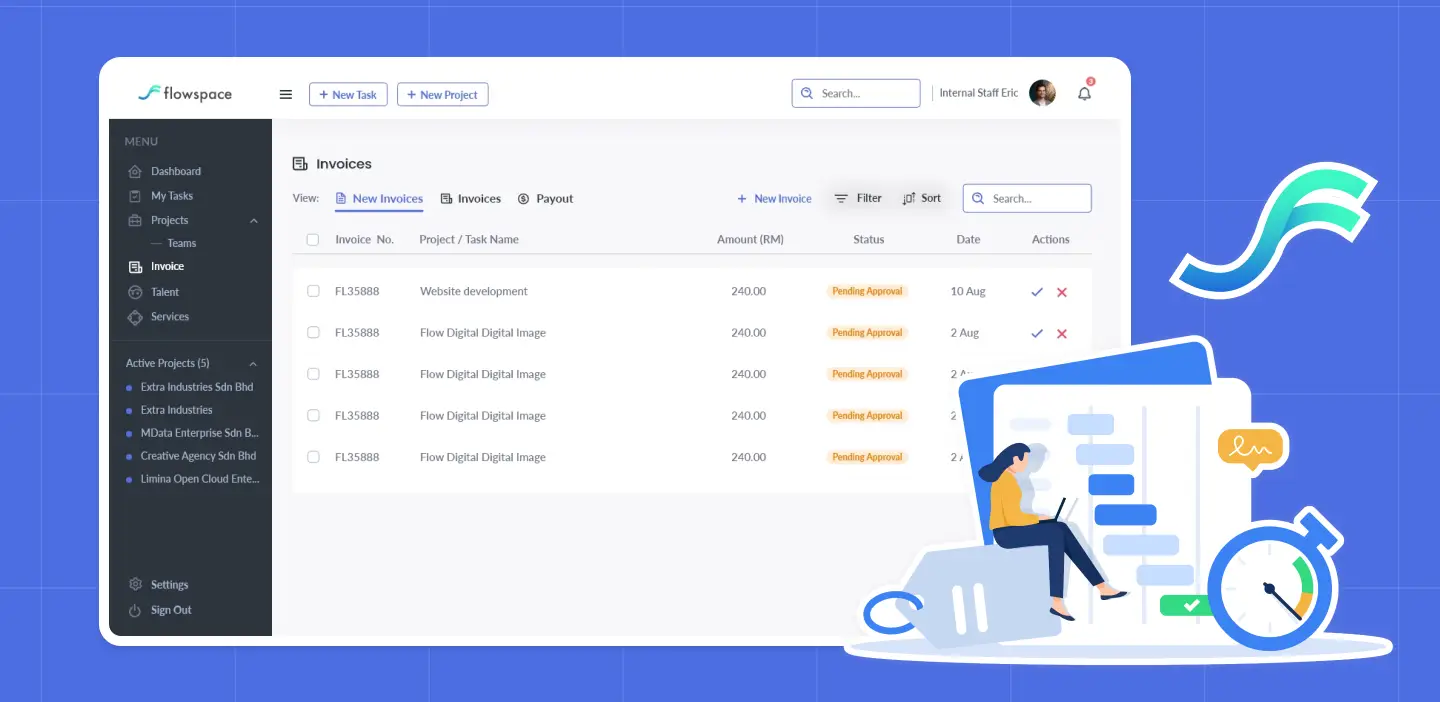
If your business is running customer relationships and sales pipelines manually or through disconnected tools, Flowhubr, Flow Digital’s CRM and business management platform, provides the foundation for automating your sales and customer workflows in a single connected system.
2. Finance and Operations
Finance is one of the most automation-ready functions in any business. Invoice processing, payment approvals, expense reconciliation, and financial reporting all follow structured logic that AI handles well. Financial institutions using AI-driven decision engines for processes like loan underwriting have reported 40% faster processing with equivalent or better accuracy.
For operations, AI workflow automation handles purchase order management, supplier communications, stock level monitoring, and compliance reporting. The common thread is that these are high-volume, rule-heavy processes where manual handling creates both cost and risk.
3. HR and Onboarding
HR teams spend a disproportionate amount of time on processes that are ripe for automation: job posting distribution, CV screening, interview scheduling, onboarding document collection, and probation reminders. According to McKinsey, up to 56% of HR tasks can be automated to reduce processing costs and time.
AI-powered onboarding workflows ensure every new hire receives the right documents, training assignments, and introductions in the right sequence, without an HR manager manually tracking each step. The result is a more consistent experience for employees and significantly less administrative load on the HR team.
4. Marketing and Lead Generation
Marketing automation is often where businesses start their AI workflow journey, but most are only scratching the surface. Beyond scheduling social posts and sending email sequences, AI workflow automation in marketing includes dynamic content personalisation, lead nurturing based on behavioural triggers, ad performance optimisation, and content distribution across channels.
According to industry data, 83% of marketing departments already automate social media posting, and 75% automate email marketing tasks. The next frontier is AI that adjusts campaign strategy in real time based on performance data, not just executing a pre-built sequence but adapting it.
The Risks Businesses Must Prepare For
AI workflow automation carries real implementation risks. The businesses that navigate this well are the ones that go in with eyes open.
Shadow AI: Unsanctioned Tools Creating Hidden Risk
When individual teams start using AI tools independently, without IT oversight, security review, or integration into core systems, you get shadow AI. Each tool might work well in isolation. Together, they create fragmented data, inconsistent outputs, duplicated processes, and security exposure that is invisible to leadership until something breaks.
Integration Complexity: When Automation Breaks at the Seams
The most common place AI workflow automation fails is at the integration points between systems. An automated workflow that works perfectly within a single platform but cannot pass data cleanly to the next system creates bottlenecks that are harder to diagnose than the manual process it replaced. Integration planning needs to happen before implementation, not after.
Over-Automation: When You Remove Too Much Human Judgment
Not every decision should be automated. Automating high-stakes, relationship-sensitive, or ethically complex decisions without adequate human oversight creates both quality and reputational risk. The best implementations establish clear decision boundaries and preserve human judgment where it matters most.
Data Readiness: Automation Is Only as Good as Your Data
This is the most common reason AI automation projects underdeliver. If the data feeding your workflows is incomplete, inconsistent, or siloed across systems that do not communicate, the automation will produce unreliable outputs. Before you automate, you need clean, accessible, well-structured data.
How Flow Digital Helps Businesses Implement AI Workflow Automation
Knowing what to do and knowing how to do it are two different problems. Most businesses have a reasonable sense of what they want to automate. Where they get stuck is in the strategy, the integration work, and making sure the whole thing holds together as a system rather than a collection of disconnected tools.
Flow Digital works with Malaysian businesses at every stage of this journey, from initial workflow audit and automation strategy through to technical implementation, system integration, and ongoing optimisation. Whether you are automating a single sales pipeline or building a cross-department workflow system, the approach is the same: start with the business outcome, build to that outcome, and measure everything.
For businesses that need a CRM and pipeline management layer to anchor their automation, Flowhubr provides a purpose-built platform that connects customer data, task management, and workflow automation in one place, designed to work seamlessly with the broader automation systems Flow Digital implements.
If you want to understand exactly where your business stands before committing to any technology investment, start with our AI Readiness Audit. It is the clearest way to identify what is ready to automate now and what needs to be fixed first.
Conclusion
AI workflow automation is not a trend that is still arriving. It is here, it is accelerating, and it is already separating businesses that operate efficiently from those that are drowning in manual processes.
The five trends covered in this article, agentic AI, hyperautomation, natural language workflow creation, predictive optimisation, and governance, are not future concepts. They are the operating reality that your competitors are beginning to deploy. Malaysia’s AI Nation 2030 agenda, backed by real government investment and a digital transformation market projected to nearly triple by 2031, means the infrastructure and policy environment are aligned in a way that rarely happens.
The businesses that prepare now, by auditing their workflows, fixing their data, starting with one high-impact automation, and building governance from the beginning, will compound those advantages over the next three to five years. The businesses that wait will spend more money catching up than they would have spent starting.
The question is not whether AI workflow automation is relevant to your business. The question is how much longer you can afford to operate without it.
Ready to Build Smarter Workflows for Your Business?
Most businesses know they should be automating more. The challenge is knowing where to start, how to connect everything, and how to make sure it actually works in practice, not just in a demo.
Flow Digital helps Malaysian businesses design, implement, and scale AI workflow automation that delivers real, measurable results. From initial strategy and workflow audit through to full technical implementation and integration, we build automation systems that fit how your business actually operates.
Whether you are starting from scratch or looking to take your existing automation to the next level, our team is ready to help.
Talk to Our AI Automation Expert with no commitment, just a straightforward conversation about where your business is and what is actually possible.
Frequently Asked Questions (FAQ)
01.What is AI token usage and why does it affect my costs?
AI token usage refers to the total number of tokens — the small units of text that AI models process — consumed across all your AI interactions in a given period. Every API call your business makes to an AI provider is charged based on the number of tokens in both your input (what you send) and the output (what the AI returns). The more tokens consumed, the higher your bill. Managing AI token usage means designing your workflows, prompts, and model selections to deliver the same business outcomes with the most efficient token footprint possible.
02.How is AI token usage different from just counting words?
Tokens are not the same as words. A token can be a word, part of a word, a punctuation mark, or a number. In English, 1,000 tokens is approximately 750 words. However, in Bahasa Malaysia, Mandarin, or Tamil, the same number of words typically requires 30 to 70% more tokens, because AI tokenisers were trained on English-dominant data and split non-English words into more fragments. This makes language choice a meaningful cost variable for Malaysian businesses.
03.How do I start budgeting for AI token usage?
Start by mapping every AI touchpoint in your business — anywhere an AI model is called. For each touchpoint, sample 15 to 20 real interactions and count the tokens using your provider’s official tool (Anthropic’s Token Counting API for Claude, OpenAI’s Tokenizer for GPT models). Calculate an average token count per interaction, multiply by daily volume, then by 30. Apply your provider’s current pricing, factor in the hidden multipliers (system prompt repetition, conversation history growth, multilingual content), and set spend alerts at 50%, 75%, and 100% of your monthly budget ceiling.
04.What is prompt caching and how much can it save?
Prompt caching allows an AI provider to store a frequently reused prompt or context block, and then charge a significantly lower rate — typically 80 to 90% less — when that same block appears in subsequent API calls rather than being processed fresh each time. For businesses that use a fixed system prompt, a shared knowledge base, or consistent background context across many daily interactions, prompt caching is often the single highest-impact cost reduction available, requiring minimal changes to existing workflows.
05.How should an enterprise govern AI token usage across departments?
Effective enterprise AI token usage governance requires three things: visibility, policy, and review. Visibility means a central dashboard showing token consumption by department or workflow, not just a total monthly invoice. Policy means clear internal rules on which model tiers are approved for which task categories and who can authorise premium model deployment. Review means a scheduled process — at least quarterly — to assess whether model tier and architecture choices remain appropriate as volumes evolve. McKinsey’s research shows that organisations with formal AI governance structures achieve 1.5 to 2 times better cost outcomes than those relying on ad hoc team decisions.
06.How do multi-agent AI workflows affect token usage and cost?
Multi-agent workflows are where token costs can genuinely surprise businesses scaling up automation. In a multi-agent setup, each agent in the chain typically receives the full accumulated context from all previous agents — meaning the same information gets tokenised and billed multiple times across a single task. A workflow that looks like one customer interaction from the outside might involve four or five internal AI calls, each with compounding input tokens. Designing efficient multi-agent architecture requires careful decisions about what context each agent genuinely needs at each step, what can be summarised rather than passed in full, and where shared context can be cached rather than re-billed.