AI marketing agents are autonomous software systems powered by large language models that plan, execute, and refine multi-step marketing operations without continuous manual prompting. For growth teams and SMEs in Malaysia, these persistent workflows replace ad-hoc prompts, reducing content turnaround times by half while operating across local customer research, funnel audits, and channel analytics within two to six weeks.
In our agency engagements at Flow Digital, we frequently meet marketing teams trapped in the copy-paste prompt loop. A typical team spends fifteen hours each week opening blank chat windows, retyping brand guidelines, and wrestling with generic copy that hallucinates product specifications. One retail client in Malaysia came to us after their internal team published social ads with incorrect bundle pricing because a copywriter used a generic prompt that invented promotional terms.
The breakdown happens because standard conversational interfaces lack persistent memory, operational playbooks, and secure connections to business data. When marketing teams treat artificial intelligence as a reactive chat assistant rather than an interconnected workforce, output quality degrades rapidly. Transitioning to dedicated marketing agents eliminates this friction by binding foundational models to structured company context, precise execution standards, and automated schedules.
AI Marketing Agent Examples and Proven Wins
Practical AI marketing agent examples deliver measurable business returns when applied to labour-heavy, repetitive marketing tasks that require analytical consistency. Instead of asking software to handle vague creative assignments, high-growth teams deploy specialised agents to conduct deep competitive scrapes, audit creative performance across ad networks, and extract buyer objections from hundreds of public reviews simultaneously.
In three recent client engagements, our team deployed focused research agents to parse thousands of customer discussions across regional forums and community channels. The agents extracted recurring purchasing hesitations in thirty-five minutes, a diagnostic task that previously consumed three days of manual reading by junior copywriters. The synthesized findings allowed the media team to refresh ad messaging with verbatim customer phrasing, increasing click-through rates by thirty percent within two weeks.
Agentic workflows also excel at ongoing diagnostic reporting. Rather than waiting for bi-weekly agency summaries, marketing managers can run diagnostic agents that ingest campaign data from advertising platforms, compare current metrics against trailing thirty-day averages, and flag anomalies immediately. When an ad creative suffers sudden frequency fatigue or a landing page exhibits mobile checkout drop-offs, the agent alerts the team with a clear hypothesis and recommended remediation steps.
AI Agents vs Prompting in Marketing Automation
Moving from reactive prompting to AI agents in marketing automation represents a fundamental shift from human-driven tool operation to supervised system orchestration. In basic prompt engineering, a human operator acts as the engine, supplying context, evaluating output quality, copying data between browser tabs, and correcting errors sequentially. When the chat session closes, the software forgets all historical guidance.
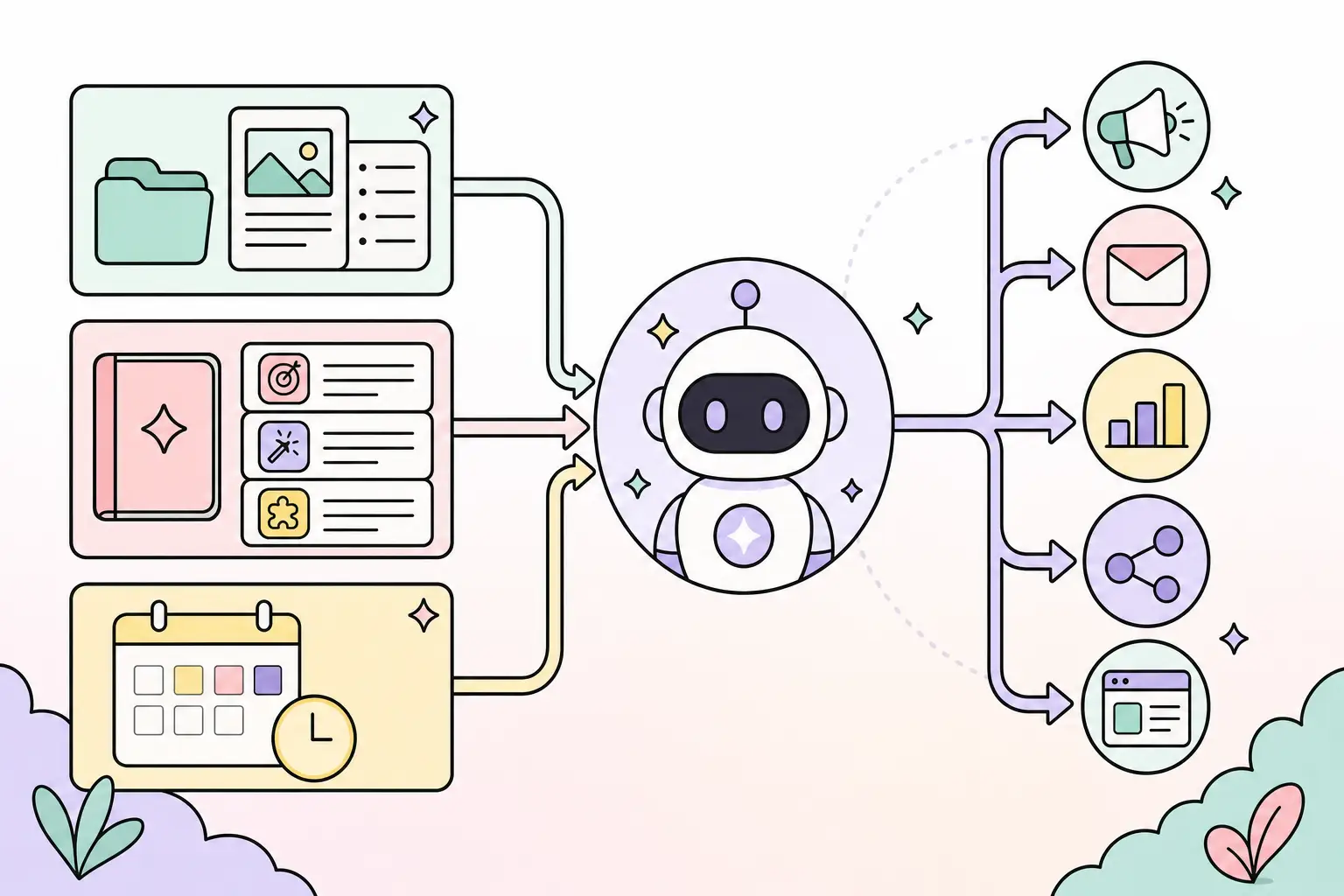
An agentic marketing architecture combines three operational layers: persistent brand context, repeatable execution procedures, and autonomous background triggers. By separating strategic context from execution logic, an agent maintains tone consistency across weeks of deliverables without human babysitting.
| Workflow Attribute | One-Off Prompting | Persistent AI Marketing Agent |
|---|---|---|
| Context Retention | Wiped after each chat session | Preserved across all executions |
| Task Complexity | Single-step text transformations | Multi-step research and tool chaining |
| Brand Voice Drift | High, requires constant re-prompting | Minimal, enforced by guardrails |
| Trigger Mechanism | Manual human input required | Automated schedules or webhooks |
| Data Integration | Manual copy-pasting into text box | Secure API connectors and live syncs |
Equipping an AI agents marketing team with this infrastructure frees specialists from administrative overhead. Copywriters evolve into creative directors who curate source knowledge, while performance marketers focus on budget allocation and offer architecture rather than manual data collation.
AI Marketing Agents for Local Audience Mining
Deploying AI marketing agents for customer sentiment analysis solves one of the steepest research hurdles in domestic commerce: understanding fragmented buyer feedback. In Western markets, audience research agents routinely scrape Reddit and review portals. In Malaysia, consumer dialogue occurs within localized environments like Facebook Groups, Xiaohongshu (RED), Shopee and Lazada product reviews, and unstructured WhatsApp customer service conversations.
Mining these domestic touchpoints manually requires dozens of hours of repetitive searching. An autonomous research agent systematically parses customer inquiries, cataloging exact vocabulary, localized vernacular, and product complaints. When setting up a ChatGPT business Malaysia workspace or a private Anthropic environment, our team feeds sanitized customer interaction logs directly into an extraction agent to isolate high-intent conversion angles.
This structured extraction consistently uncovers friction points that conventional surveys overlook. In a project for a domestic consumer brand, our audience research agent identified that forty percent of abandoned checkout questions stemmed from confusion over local delivery options and installment plans. Translating those verbatim customer concerns into dedicated ad copy and checkout page banners eliminated the objection before visitors dropped off.
How Do Competitor Research Agents Audit Funnels?
Automated competitor audits allow marketing teams to dissect competing promotional strategies without manually clicking through dozen-step sales funnels. Using structured scripts, a research sub-agent navigates competitor landing pages, captures pricing variations, documents promotional bundles, and extracts unique value propositions into an updated matrix.
Running systematic ChatGPT competitive analysis through an agentic workflow eliminates subjective guesswork. The agent compares competitor headline structures, call-to-action choices, lead magnet topics, and checkout guarantees against your own product hierarchy. Instead of an unfocused text summary, the agent outputs a side-by-side gap analysis highlighting underserved positioning angles.
Teams operating in competitive verticals use these automated audits to maintain pricing agility. When a competitor launches a limited-time flash discount or introduces a revised warranty tier, a scheduled research agent detects the change on public landing pages and summarizes the shift for your commercial team. This proactive intelligence allows brands to adjust campaign hooks before losing market share.
AI Workflow Automation Across Ad Channels
Deploying AI workflow automation tools across paid advertising accounts bridges the communication gap between Meta Ads Manager, Google Ads, and internal sales records. Most growing businesses track marketing expenditure across separate ad consoles while logging reconciled revenue in offline spreadsheets or accounting software, leaving significant blind spots in cross-channel attribution.
An analytical marketing agent queries ad platform APIs alongside your lead tracking sheets to perform automated diagnostic cross-checks. Instead of merely reporting cost per click, the agent evaluates operational hypotheses. For example, if advertising spend remains steady while qualified inquiries drop, the agent analyzes device-level conversion paths, isolating whether an unannounced mobile theme update broke form submission fields on cellular networks.
Automating this diagnostic layer directly counters ad fatigue. By tracking creative frequency, first-time impression ratios, and conversion degradation across individual ad sets, an analytical agent flags diminishing returns before budget is wasted. The media buyer receives a prioritized action checklist each morning, indicating exactly which creative assets require immediate rotation.
Generative Engine Optimization Content Workflows
Generative engine optimization represents the evolution of search strategy, focusing on securing brand visibility and direct citations within conversational search engines. As consumers turn to Google AI Overviews, Perplexity, and ChatGPT Search for commercial recommendations, standard keyword stuffing fails to earn visibility. AI search models prioritize authoritative entity definitions, verified original data, and clear structural hierarchy.
Marketing teams use specialized content agents to reverse-engineer conversational search results for target product categories. An agent analyzes current generative outputs across major conversational engines, identifies which industry sources are cited, and maps out semantic query fan-out patterns. These fan-out maps reveal the logical follow-up questions consumers ask after an initial product query.
Armed with this diagnostic blueprint, editorial agents draft comprehensive content outlines that explicitly answer downstream buying questions. Flow Digital builds content strategies designed to capture AI engine citations, incorporating structured tables, unambiguous factual claims, and proprietary operational observations that search models easily parse and index. Teams curious about their search readiness can audit their technical setup through our guide on website optimization for AI search.
5 Steps for Building Marketing AI Agents
Establishing an internal agent network requires an engineering framework that prioritizes data integrity, brand governance, and human supervision over unguided autonomy. We recommend following five deliberate implementation phases:
- Brand Context Curation: Assemble verified company documentation into an isolated project workspace, including your positioning hierarchy, pricing structures, customer personas, brand tone guardrails, and explicit negative constraints that forbid unapproved claims.
- Modular Playbook Engineering: Convert standard marketing operating procedures into modular execution skills, defining unambiguous input triggers, sequential processing stages, output formatting templates, and strict evaluation rubrics for the agent to follow.
- Data Connector Integration: Connect secure application programming interfaces linking the agent to essential operational tools, such as your advertising dashboards, customer relationship management software, website content management systems, and centralized storage folders.
- Human Review Checkpoints: Build human-in-the-loop review gates into high-risk workflow stages, requiring marketing specialists to evaluate and sign off on strategic plans, creative ad drafts, and competitive claims before publication.
- Scheduled Autonomous Execution: Set deterministic recurring triggers that run data compilation, audience research mining, and diagnostic ad performance checks at designated intervals without requiring human initiation.
For companies evaluating the operational investment required to integrate custom workflows, reviewing our breakdown of the hidden costs of AI automation helps prevent common budgetary miscalculations.
Looking to automate your marketing workflows with reliable, enterprise-grade AI agents? Flow Digital designs and implements custom agent architectures tailored to your business operations.
What Do Marketing AI Agents Cost in Malaysia?
Understanding software subscription tiers and implementation overhead enables realistic capital planning for automation initiatives. In Malaysia, commercial LLM platform pricing varies from entry-level software-as-a-service accounts to dedicated enterprise workspaces, and unexpected API consumption fees can catch unprepared teams off guard. A foundational software stack for marketing agents typically combines enterprise team accounts with workflow automation tools. Dedicated team workspaces on major LLM providers generally range from RM110 to RM160 per user monthly, offering administrative controls and data privacy protections that prevent public model training. Connecting these models to low-code integration platforms like Make or n8n introduces platform fees ranging between RM90 and RM450 monthly, alongside metered API token usage that averages RM150 to RM600 per month for moderate marketing workloads.
Custom agency deployment for specialized marketing agents in Malaysia generally costs between RM8,000 and RM28,000 as a one-time project fee, depending on pipeline complexity and custom API connectors. Deployment timelines typically run from two to six weeks, covering context curation, playbook authoring, data sanitization, and team enablement. Malaysian enterprises modernizing their technology stack can explore adoption support and digitization initiatives through the Malaysia Digital Economy Corporation.
Commercial teams must also maintain rigorous compliance with domestic data regulations. Under the Personal Data Protection Department enforcing the Personal Data Protection Act (PDPA 2010), businesses are legally accountable for safeguarding consumer information. Customer phone numbers, email addresses, and identification records must be systematically stripped or anonymized before uploading chat transcripts or CRM records to cloud AI systems. Be careful of technology vendors quoting under RM3,000 for full custom agent setups; these offerings almost always turn out to be brittle, single-prompt wrappers built inside basic consumer interfaces that lack security safeguards, API error handling, and persistent memory.
Streamline Marketing Workflows with Flow Digital
Flow Digital builds custom, enterprise-compliant AI marketing agents and integrated operational workflows for SME owners in Malaysia. Having guided dozens of commercial teams through digital transformations, we combine practical marketing domain expertise with robust software engineering to eliminate operational drag. If your team is struggling with inconsistent AI outputs and fragmented marketing data, these are the pieces we handle:
- Operational AI Audits: Pinpointing high-impact marketing bottlenecks where agentic automation saves immediate team hours.
- Persistent Workspace Architecture: Structuring secure brand context, execution playbooks, and model guardrails that eliminate hallucinated messaging.
- Local Voice-of-Customer Mining: Deploying autonomous extraction agents across domestic social and e-commerce touchpoints to uncover conversion angles.
- Competitive Funnel Intelligence: Establishing automated tracking sub-agents that monitor competitor pricing, offers, and messaging shifts.
- Cross-Channel Ad Analytics: Unifying fragmented data streams across ad networks to isolate conversion leaks and ad creative fatigue.
- Generative Engine Optimization: Structuring digital assets and content architectures to capture citations across conversational search platforms.
- Turnkey Agent Implementation: Engineering end-to-end automations connecting your LLM workspaces to production tools via low-code and API pipelines.
- Governance and PDPA Compliance: Implementing strict data sanitization and privacy controls that protect customer data while leveraging cloud models.
Find out more about our AI digital transformation services at flowdigital.my, or message us and we will walk through your marketing automation roadmap with you.
Get in touch
WhatsApp: +60108861055
Email: [email protected]
Start a WhatsApp conversation →
Frequently Asked Questions
What are AI marketing agents and how do they differ from ChatGPT?
AI marketing agents are autonomous systems that plan, execute, and refine multi-step operational tasks by connecting large language models to persistent company memory, standard operating playbooks, and external software tools. Unlike conversational ChatGPT sessions that require manual human prompting for every single instruction and forget historical context once closed, marketing agents execute complex sequences independently across ad platforms, web research, and analytical reporting.
How much does deploying AI marketing agents cost in Malaysia?
Deploying AI marketing agents in Malaysia typically involves software licensing costs between RM250 and RM750 per month for enterprise LLM seats and workflow automation connectors, plus metered API usage. Custom engineering and implementation by experienced workflow specialists generally ranges between RM8,000 and RM28,000 as a one-time project fee, depending on the number of automated channels and data integrations required.
Can AI marketing agents handle multi-language content for Malaysia?
AI marketing agents handle multi-language content effectively when configured with localized linguistic guardrails. Modern foundation models easily process Bahasa Melayu, English, and Mandarin, but standard prompts often struggle with colloquial Malaysian phrasing. By encoding localized vocabulary, tone examples, and cultural nuances directly into persistent agent skill playbooks, the system drafts authentic copy while avoiding awkward translations.
Is customer data uploaded to AI marketing agents compliant with Malaysia's PDPA?
Customer data uploaded to commercial AI models is only compliant with Malaysia’s Personal Data Protection Act if personal identifiers are thoroughly scrubbed before transmission. Enterprise software tiers from reputable providers guarantee that uploaded customer data is not used to train public foundational models, but organizations must still implement data masking pipelines that remove names, phone numbers, and addresses.
How long does it take to implement an AI marketing agent workflow?
Implementing an AI marketing agent workflow typically takes between two and six weeks from initial discovery to active deployment. Phase one focuses on collating brand context, customer personas, and playbooks over the first seven to ten days. Phase two involves building tool integrations, testing prompt reliability, establishing human-in-the-loop review checkpoints, and training internal staff on supervision.
Can AI agents automate ad reporting from Meta and Google Ads?
AI agents automate ad reporting across Meta Ads and Google Ads by pulling platform performance metrics via API endpoints into a unified diagnostic workspace. Beyond generating static metric summaries, an analytical agent evaluates specific hypotheses, such as identifying creative ad fatigue, pinpointing mobile conversion drop-offs, and alerting media buyers to budget allocation anomalies in real time.
How is Flow Digital different in deploying marketing AI workflows?
Flow Digital approaches marketing AI deployment from an engineering and performance marketing standpoint rather than selling generic prompting workshops. We build secure, custom agent architectures integrated directly into your existing marketing stack, implementing rigorous data privacy controls under PDPA and ensuring your internal team retains full oversight through structured human-in-the-loop checkpoints.