


In 2025, global e-commerce is projected to surpass $7 trillion in sales and competition has never been more intense. Businesses are no longer just managing online stores; they’re managing complex ecosystems of data, marketing tools, customer touchpoints, and supply chains. Yet many merchants still struggle to connect these moving parts, leading to inefficiencies, missed opportunities, and inconsistent customer experiences.
That’s where Shopify integrations make all the difference. By connecting your Shopify store with tools like CRMs, analytics platforms, marketing apps, and logistics systems, you can automate repetitive tasks, centralize your data, and make smarter, faster decisions. Integrations help your store evolve from a simple sales platform into a connected digital hub — one that unites marketing, operations, and customer insights in real time.
In this article, we’ll explore:
The challenges businesses face in today’s fragmented e-commerce landscape.
How Shopify integrations streamline workflows and boost performance.
The types of integrations that deliver the biggest impact for growth.
Real examples of how connected systems improve marketing, sales, and customer retention.
If your business is ready to move beyond manual processes and start operating like a data-driven digital brand, read on — because Shopify integrations could be the key to unlocking your next stage of growth.
What Is Social Commerce?
Social commerce is the seamless fusion of social media and online shopping where discovery, engagement, and purchase all happen within a single platform. Instead of driving users from Instagram or TikTok to a separate website, social commerce allows them to buy products directly where they scroll, watch, and interact.
At its core, social commerce is powered by trust and convenience. Consumers no longer browse social platforms just for inspiration; they rely on creator recommendations, social proof, and real-time engagement as validation for purchase decisions. From Instagram Shops and TikTok Shop to Pinterest Buyable Pins, every platform is evolving into a commerce-enabled environment.
For brands, this creates both opportunities and challenges. The upside lies in reaching consumers during their highest engagement moments; the challenge lies in managing product data, tracking conversions, and turning fleeting likes into measurable transactions.
This is where Shopify becomes indispensable by connecting these fragmented touchpoints into a single, measurable system that brings social engagement and e-commerce under one roof.
The Evolution of Social Commerce
Social commerce didn’t appear overnight — it evolved through several key phases shaped by changing consumer habits and technology.
- 2017–2020: The “Link in Bio” Era
Brands and influencers began driving sales through Instagram and YouTube, but purchases still happened off-platform. Trust in creators grew, yet the path from discovery to checkout was long and full of drop-offs. - 2020–2022: Platform Storefronts Take Over
The pandemic accelerated digital shopping, and platforms like Facebook, Instagram, TikTok, and Pinterest launched native “Shop” features. For the first time, users could browse and buy without leaving their favorite apps. Shopify integrations also matured, allowing merchants to sync products and track conversions easily. - 2023–2025: The Age of Personalization and Real-Time Commerce
AI recommendations, shoppable videos, and livestream selling made social commerce fully mainstream. Consumers expect instant, in-app purchases and relevant product suggestions. Every click now feeds first-party data, helping brands refine targeting and optimize marketing performance.
In short, social media has evolved from a discovery tool into a sales engine, and Shopify sits at the center, connecting these social ecosystems directly to your e-commerce operations.
How Social Commerce Differs from Traditional E-Commerce
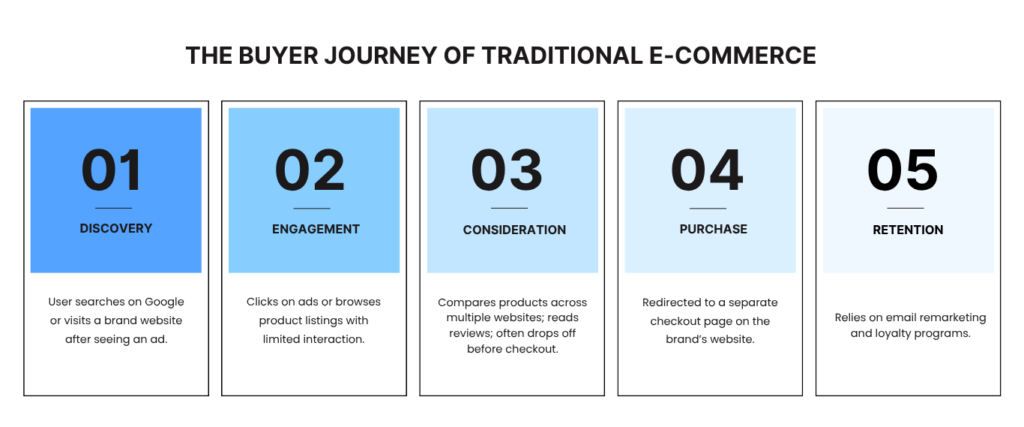
In traditional e-commerce, the journey is linear: people search for a product, land on a website, browse, and eventually buy. The process depends heavily on intent-based search and paid ads to drive traffic. Brands must constantly fight for visibility through SEO and advertising spend, and the moment a visitor leaves the site, the connection is often lost.
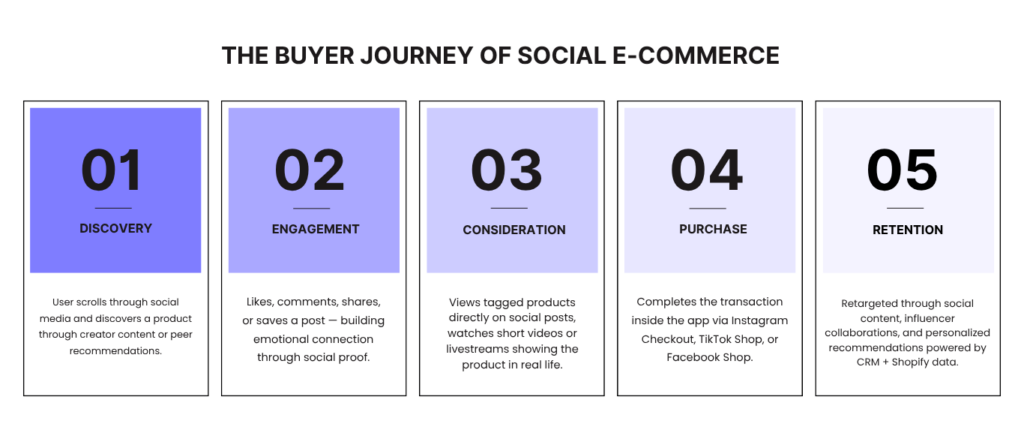
Social commerce, on the other hand, turns that model upside down. Discovery happens naturally while users scroll through their feeds. A product is introduced through a trusted creator, a viral video, or a community recommendation and the purchase can happen instantly within the same app. The funnel has collapsed: content, engagement, and checkout now exist in one experience.
What makes social commerce powerful isn’t only convenience — it’s context and community. Consumers are influenced by real interactions: comments, shares, and authentic creator endorsements. Rather than clicking through ads, they’re buying through relationships. Research by Accenture found that 63% of consumers are more likely to purchase from brands that offer social shopping experiences, driven by trust and peer validation
For merchants, this shift means moving from traffic acquisition to relationship building. he goal is no longer to push users into a checkout funnel but to nurture them through meaningful engagement. Shopify’s native integrations make this possible, linking product catalogs, analytics, and CRM data directly with social platforms to bridge every touchpoint between discovery and conversion.
In short, traditional e-commerce drives sales through search; social commerce drives sales through community and Shopify gives you the tools to bridge both worlds seamlessly.
Why Do Businesses Need Shopify Integration on Their Website?
In today’s digital marketplace, customers expect every online experience to be fast, connected, and personalized. Businesses need Shopify integration on their websites to create a connected, data-driven commerce ecosystem that meets modern customer expectations for speed and personalization. While a standalone e-commerce site can process transactions, integration links it with key channels like social media, CRM systems, and analytics tools — turning scattered data into actionable insights. This unified setup keeps products, orders, and inventory synchronized across every platform, ensures consistent customer experiences, and enables smarter marketing through automation and real-time performance tracking. Ultimately, Shopify integration transforms a basic online store into a scalable growth engine that drives both efficiency and revenue.
In short, businesses need Shopify integration because it:
In short, businesses need Shopify integration because it:
Unifies operations — connects storefront, CRM, and social platforms for seamless management.
Improves customer experience — delivers consistent information and faster, smoother checkout journeys.
Enhances marketing efficiency — provides real-time analytics to optimize campaigns and budget allocation.
Boosts scalability — supports automation that grows with your business, not against it.
For enterprise, integration is what turns a basic Shopify site into a smart commerce engine capable of competing in an omnichannel world.
How Can Shopify Integrations Simplify Your Social Commerce Strategy?
As social platforms evolve into powerful sales channels, the real challenge for merchants is managing it efficiently across multiple apps, ads, and audiences. Shopify connects your store directly with social platforms like Instagram, Facebook, TikTok, and Pinterest, allowing your product catalog, orders, and customer data to stay perfectly aligned. When you update a product or price in Shopify, it automatically syncs across all linked channels. Each tagged post or video becomes a potential storefront, and every click, view, or comment is tracked as part of a larger customer journey.
Here’s how these integrations streamline your strategy:
1. Centralized Catalog Management
Managing separate product catalogs for Instagram, TikTok, and Facebook often causes inconsistent pricing, outdated stock, and manual errors that confuse customers and lead to lost sales. Shopify solves this with a centralized product sync that automatically updates titles, prices, images, and inventory across every connected social shop whenever you make a change in your main store. This not only reduces manual work and human error but also ensures customers always see accurate, consistent information — strengthening trust and brand credibility across all platforms.
2. Shoppable Content
Many brands struggle to convert social engagement into actual sales because users must leave the app to complete their purchase — a friction point that kills conversion rates. Shopify solves this by enabling shoppable posts across Instagram, Facebook, TikTok, and Pinterest, where customers can tap tagged products and buy instantly within the same app. This integration shortens the buying journey, boosts conversion rates, and transforms social content from passive engagement into a direct sales engine.
3. Pixel & Conversion Tracking
Without precise tracking, it’s nearly impossible to know which posts or ads drive real revenue — leading to wasted ad spend and guesswork. Shopify’s integration with Meta Pixel, TikTok Pixel, and UTM tracking brings full visibility into campaign performance by connecting engagement data with completed transactions. This unified tracking framework empowers marketers to make data-driven decisions, optimize ad spend, and improve ROI across every social channel.
4. Unified Customer Data
When customer activity is scattered across platforms, personalization becomes nearly impossible. Shopify solves this by combining all engagement, order, and behavioral data into a single unified CRM dashboard, creating a complete customer view. This centralization enables smarter segmentation, more relevant retargeting, and personalized offers, ultimately increasing loyalty, repeat purchases, and customer lifetime value.
5. Automated Campaign Optimization
Marketing teams often waste time manually adjusting ads, testing audiences, or reallocating budgets without clear insights. Shopify’s real-time analytics and CRM-driven automation identify which platforms, creatives, and audiences deliver the best results — and automatically optimize future campaigns. This reduces manual effort, maximizes ad efficiency, and lets teams focus on what truly matters: storytelling, content strategy, and long-term brand growth.
In essence, Shopify integrations simplify complex social commerce workflows — syncing products, tracking performance, unifying data, and automating marketing so businesses can spend less time managing platforms and more time converting followers into loyal customers.
15 Shopify Integrations You Can Build with Flow Digital for Your Shopify Store
1. Shopify Marketing Integration with HubSpot
Supercharge your Shopify store’s marketing by integrating it with HubSpot — a complete CRM and automation powerhouse. This connection lets you create targeted email campaigns, manage leads, and track every customer journey in one platform. Sync your Shopify customer and order data directly into HubSpot to personalize messages, automate abandoned cart reminders, and design multi-step workflows that nurture buyers from first click to repeat purchase. You can even link HubSpot with Google Ads to measure campaign ROI and optimize customer acquisition costs. The result? A marketing engine that’s smarter, faster, and perfectly in tune with your customers’ needs.
2. Shopify Email Automation with Klaviyo
Take your retention strategy to the next level with Klaviyo, the ultimate email and SMS marketing integration for Shopify. Klaviyo automatically segments your customers based on behavior, purchase history, and engagement — helping you send the right message at the right time.
From abandoned cart reminders and post-purchase thank-you notes to loyalty rewards and reactivation campaigns, every touchpoint is personalized for maximum impact.
This integration turns your Shopify data into actionable insights, improving open rates, driving repeat orders, and increasing lifetime customer value (LTV) effortlessly.
3. Shopify CRM Integration with Zoho
Simplify customer management and boost retention by connecting your Shopify store with Zoho CRM. This integration automatically syncs customer profiles, purchase data, and communication logs, giving your sales and marketing teams a unified view of every shopper. You can set automated follow-ups, assign leads, and track deal progress — all while keeping your customer information accurate and up to date. By aligning your Shopify sales data with Zoho’s CRM automation, you’ll build stronger relationships, improve customer satisfaction, and close more repeat sales with less effort.
4. Shopify Social Commerce Integration with TikTok Shop
Tap into one of the fastest-growing sales channels with TikTok Shop. By integrating your Shopify store, you can showcase and sell products directly through TikTok videos, live streams, and creator content. This integration automatically syncs your catalog, prices, and inventory so your products stay up to date across both platforms. Track engagement, clicks, and sales performance in real time while reaching new audiences where they spend the most time. Turn your TikTok content into conversions and make every viral moment shoppable with a seamless TikTok-Shopify integration.
5. Shopify Retargeting Integration with Meta Pixel
Never lose a potential customer again with the Meta Pixel integration. By connecting Facebook and Instagram ad data directly to your Shopify store, you can retarget visitors who viewed products but didn’t complete checkout. Every view, click, and add-to-cart event is tracked, allowing you to build high-intent audiences and run laser-focused campaigns. This powerful integration helps you reduce wasted ad spend, optimize creative performance, and increase conversions with precision targeting based on real customer behavior.
6. Shopify Ad Optimization with TikTok Pixel
Unlock deeper insight into your TikTok ad performance by integrating TikTok Pixel with your Shopify store. This connection tracks every customer action — from product views to purchases — giving you clear visibility into which ads actually drive conversions. With this data, you can refine your targeting, improve creative strategies, and build high-performing lookalike audiences. The result? Higher ROI, more relevant ads, and better alignment between content engagement and actual sales.
7. Shopify Analytics Integration with Google Analytics 4 (GA4)
Gain a complete, data-driven view of your Shopify store with Google Analytics 4. This integration connects your traffic, sales, and behavior metrics into one streamlined dashboard. You can track user journeys across devices, monitor conversion funnels, and identify which marketing channels deliver the best results. By understanding exactly how customers interact with your store, you’ll make smarter marketing decisions, allocate ad budgets efficiently, and improve long-term profitability.
8. Shopify Checkout Integration with Shop Pay
Speed matters — and Shop Pay delivers one of the fastest, most secure checkout experiences in e-commerce. By integrating it with your Shopify store, returning customers can complete purchases in seconds using saved payment and shipping details. Shop Pay also supports eco-friendly carbon offsetting, giving your brand a sustainability edge. This integration helps reduce cart abandonment, boost conversions, and build customer trust with a checkout experience designed for convenience.
9. Shopify Payment Integration with PayPal & Stripe
Give your customers the flexibility to pay their way with PayPal and Stripe. These trusted global payment gateways integrate seamlessly with Shopify, supporting multiple currencies and secure transactions across markets.
They enable recurring payments, subscription models, and cross-border commerce with ease. The impact? Increased customer confidence, higher checkout completion rates, and access to a broader global audience.
10. Shopify Mobile Payment Integration with Apple Pay & Google Pay
Simplify mobile shopping with one-tap payments using Apple Pay and Google Pay. These integrations make checkout effortless on smartphones and tablets — no need to re-enter card details. This speed and convenience significantly reduce cart abandonment, especially among mobile-first shoppers. It’s the perfect solution for businesses targeting younger, tech-savvy audiences who value speed and simplicity.
11. Shopify Fulfillment Integration with ShipStation
Streamline order fulfillment with ShipStation, a leading shipping automation platform for Shopify merchants. Once integrated, it automatically imports orders, prints labels, and syncs tracking information across carriers. This eliminates manual shipping tasks, minimizes delivery errors, and ensures faster dispatch times. Your customers enjoy real-time updates and reliable delivery — boosting satisfaction and repeat sales.
12. Shopify Customer Support Integration with Gorgias
Deliver outstanding customer service with Gorgias, a helpdesk built specifically for Shopify stores. It centralizes all your support tickets, emails, chats, and social DMs in one place. Support agents can view order details and respond directly from the same dashboard, improving resolution time. This integration enhances customer satisfaction, increases retention, and allows your team to handle more inquiries efficiently.
13. Shopify Live Chat Integration with Tidio
Turn visitors into buyers with Tidio, an AI-powered chat and automation platform. By connecting it to Shopify, you can answer customer questions instantly, recommend products, and recover abandoned carts through automated messages. It also lets you collect leads and trigger personalized follow-ups. The impact? More engaged customers, faster responses, and improved conversion rates.
14. Shopify Review & Loyalty Integration with Yotpo
Build trust and boost repeat purchases with Yotpo, a powerful review and loyalty integration. Automatically collect verified customer reviews, display star ratings, and reward shoppers with loyalty points. Positive feedback and user-generated content strengthen brand credibility and influence new buyers. Yotpo turns happy customers into brand advocates — driving both reputation and retention.
15. Shopify Social Advertising Integration with Facebook & Instagram Ads
Power your ad campaigns by syncing Shopify with Facebook and Instagram Ads Manager. This integration ensures every product, price, and inventory change updates automatically in your ad catalog. You can run dynamic product ads and track conversions effortlessly. This level of automation saves time, prevents ad errors, and maximizes return on ad spend (ROAS) through precision targeting.
Who Needs Shopify Integration?
Shopify integrations are a must-have for businesses aiming to boost efficiency, cut down manual work, and deliver smoother customer experiences. If your daily operations feel disconnected or time-consuming, integrations can help you connect your tools, automate key processes, and turn data into action.
Here are a few signs that your business is ready for Shopify integrations:
You’re updating inventory by hand across multiple platforms or marketplaces.
Order fulfillment and shipping are becoming hard to track or manage efficiently.
You’re juggling different apps for marketing, accounting, and customer support, without a unified system.
You’re losing potential sales because your marketing or website lacks personalization.
You’re repeating manual tasks that could easily be automated.
You’re not fully utilizing simple tools like Google Sheets, CRM systems, or analytics dashboards.
Shopify integrations address these pain points by linking your store to essential apps and systems — giving you automation, accurate data, and better insights. Whether you’re a new online seller, a scaling e-commerce brand, or an established enterprise, integrations let you work smarter, make faster decisions, and focus on what truly drives growth: serving your customers and building your business.
Partnered with Flow Digital to Automate Your Shopify Operations
In today’s fast-moving digital marketplace, success is about having a connected ecosystem that runs efficiently and adapts quickly. Shopify integrations make that possible by linking every part of your business from marketing and payments to inventory and analytics into one seamless platform.
With the right integrations, you can automate repetitive tasks, gain real-time visibility into performance, and deliver a more personalized shopping experience that keeps customers coming back. Whether you’re a small business trying to save time or an established brand looking to scale, Shopify integrations turn complexity into clarity, helping you work smarter, grow faster, and compete stronger.
At Flow Digital, we help businesses like yours design and implement the perfect Shopify integration strategy — one that saves time, drives measurable results, and sets the foundation for sustainable growth. If you’re ready to take your e-commerce operations to the next level, contact the Flow Digital team and let’s build a smarter, more connected Shopify ecosystem together.