For many online retailers, the digital landscape is changing faster than ever — and the old rules for visibility are shifting under your feet. Imagine spending weeks and thousands of ringgit optimizing your site for Google, only for your customers to skip your storefront entirely and ask ChatGPT: “Show me a good wireless speaker under RM300.”
Beginning in 2025, OpenAI quietly added Shopify as a shopping search partner, allowing product data from Shopify merchants to surface directly in ChatGPT’s shopping experience. Moreover, OpenAI has formalized partnerships with Shopify and Etsy to enable “Instant Checkout” — letting users actually purchase items from inside ChatGPT conversations.
These moves alone have already triggered a new pain point for merchants:
Your SEO work and Google ads may no longer guarantee visibility if users skip search engines altogether.
Products must now compete in a conversational, intent-driven marketplace inside AI.
A missing or poorly structured product feed could mean your items never show up to begin with.
In short, the shift toward AI-based shopping assistants is not just a new channel — it’s a potential disruption to how your customers discover and buy. If your products don’t appear in ChatGPT, they may as well be invisible.
In this guide, we’ll help you navigate this major ecommerce shift by breaking down how ChatGPT Shopping works, what influences your product rankings, and the steps to optimize your Shopify (or non-Shopify) store for AI visibility.
Why Shoppers Are Moving to AI (and Why It Affects Your Sales)
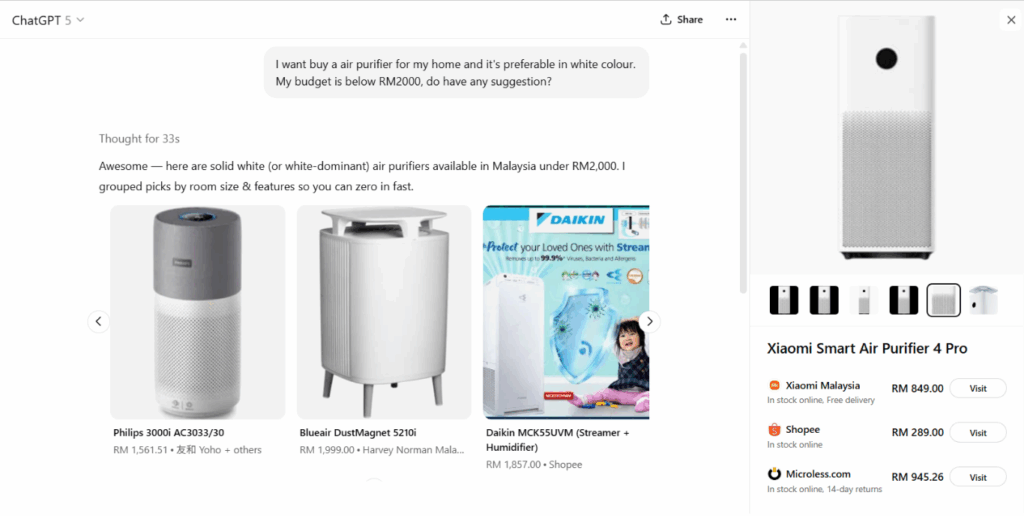
The way people shop online has fundamentally changed. Instead of browsing pages of Google results or endless marketplace listings, users now describe what they want — naturally and conversationally:
“Best gaming chair for home office under RM600”
“Eco-friendly skincare for sensitive skin”
“Shoes similar to Nike Air Force 1 but cheaper”
ChatGPT then searches through connected merchant feeds, compares products, and displays options that best match the user’s intent — complete with descriptions, prices, and links.
For ecommerce owners, this introduces a new kind of ranking challenge — called LLM Shopping Visibility.
Just as SEO determines how your products rank on Google, Generative Engine Optimization (GEO) determines how they appear in ChatGPT and other AI-driven search engines.
How ChatGPT Shopping Works
OpenAI launched ChatGPT Shopping alongside the Agentic Commerce Protocol (ACP) — a new data format that allows ChatGPT to pull verified product information directly from merchant feeds.
When a user searches for a product, ChatGPT:
Pulls product data from verified ecommerce feeds (Shopify, Walmart, Etsy, and more).
Ranks them based on relevance, trust, and freshness.
Displays them as interactive product cards or lists — sometimes with direct checkout options.
Your product’s visibility in ChatGPT depends on how well your store data aligns with user intent, and how structured and updated your product feed is.
What Determines Ranking in ChatGPT’s Shopping Feed
Unlike Google’s keyword-focused algorithm, ChatGPT’s ranking is intent-driven and data-quality dependent. Here are the five key factors that influence your ranking:
1. Structured Product Feed (ACP-Compliant)
Your ecommerce platform must supply a structured product feed that ChatGPT can interpret. Each product should include:
Product ID
Title & description
Price & stock status
Images & variants
Brand & merchant details
Return & shipping policy URLs
2. Freshness and Accuracy
Feeds that update regularly and ideally every 15 to 60 minutes, are prioritized, especially for inventory and pricing accuracy.
3. Trust and Brand Reputation
Verified merchants, especially Shopify stores, are ranked higher thanks to built-in identity validation and secure checkout systems.
4. Schema and Metadata Alignment
Your on-site schema (Product, Offer, Review) must match your feed data. Any mismatch can lower your ranking.
5. Review and Engagement Signals
Positive reviews, customer engagement, and low return rates act as trust signals that boost your product visibility.
If your goal is to rank your ecommerce products in ChatGPT’s search results, you’ll need to optimize across these five pillars.
How to Rank Your Shopify Store in ChatGPT (Step-by-Step)
Here’s a practical guide for Shopify store owners to increase their ChatGPT visibility:
Step 1: Ensure Eligibility
Connect your Shopify store to OpenAI’s Shopping Search Partner Program (available in expanding regions). This makes your product feed accessible to ChatGPT automatically. As of October 2025, OpenAI’s Instant Checkout (via ACP) is live in limited markets — starting in the U.S. through Etsy and select Shopify partners.
Step 2: Clean and Optimize Product Data
Keep product titles clear, conversational, and human-friendly.
- Bad: “Model X123 – Black”
- Good: “Lightweight Noise-Cancelling Headphones (Black, 30H Battery)”
Use natural keywords customers might say aloud: “for beginners,” “affordable,” “eco-friendly.”
Step 3: Use Full Product Schema
Ensure every product page includes Product and Offer schema, plus rating and review markup to help ChatGPT cross-verify your listings.
Step 4: Update Feeds Frequently
Sync your product feed at least every few hours. Outdated stock or prices can cause ChatGPT to skip your products.
Step 5: Include Media-Rich Content
ChatGPT favors products with context include high-quality images, videos, or 3D product models that can appear in AI carousels.
Step 6: Strengthen Merchant Trust
Provide transparent links to your shipping, warranty, and return policy pages. ChatGPT prioritizes trustworthy merchants.
Step 7: Conversational Keyword Optimization
Optimize for natural, question-style searches like:
“Best budget smartwatch under RM500”
“Organic tea made in Malaysia”
This helps ChatGPT better understand your product’s intent and context.
What If You’re Not Using Shopify for Your Website?

If your online store runs on WooCommerce, Magento, Wix, or a custom-built platform, you might be worried: “Does that mean my products won’t appear in ChatGPT shopping results?”
The short answer: you still can — but it takes a bit more work.
While Shopify merchants now have a built-in integration with ChatGPT’s shopping ecosystem through OpenAI’s partnership, other ecommerce platforms currently need to connect manually using the Agentic Commerce Protocol (ACP) — the standardized format that allows ChatGPT to display verified merchant products.
Here’s how you can make your products discoverable even without Shopify:
Create a product feed in OpenAI ACP format (CSV, JSON, or XML).
Include accurate product data: titles, links, images, and pricing.
Submit your feed through OpenAI’s merchant registration or an approved partner platform.
Add structured schema (Product, Offer, Review) to your website for better AI recognition.
Sync your feed daily to ensure your listings stay up to date.
The key difference? Shopify automates most of this, while other platforms require more technical setup — which can be challenging for smaller teams.
That’s where Flow Digital comes in. We help Malaysian businesses bridge this gap by mapping product data to ACP standards, automating schema markup, and optimizing for Generative Engine Optimization (GEO). This ensures your products stay visible and competitive inside ChatGPT shopping results — even if you’re not on Shopify.
How Experts Can Help You Rank Faster
Because AI-powered shopping is still new, most traditional SEO agencies aren’t fully equipped for it yet. To succeed, you’ll need a GEO (Generative Engine Optimization) specialist who understands:
Product feed mapping for ACP compliance
Conversational keyword optimization
Schema and metadata alignment
Merchant verification setup
Regional feed localization
These aren’t your typical SEO tweaks — they’re data-driven, technical strategies designed specifically for AI visibility.
The Future: GEO Is the New SEO
Generative Engine Optimization (GEO) is redefining digital marketing. Instead of just optimizing for Google or Bing, GEO helps your brand appear within AI-driven search tools like ChatGPT, Perplexity, and Gemini.
As AI assistants become the new starting point for online shopping, your product data quality, structure, and trust signals will decide whether your products are even seen.
If you’re serious about ranking your Shopify or ecommerce products in ChatGPT’s shopping results, now is the time to adapt.
Rank Higher in ChatGPT with GEO Optimization
ChatGPT is redefining how consumers discover and shop online, shifting visibility from traditional SEO to a new era driven by AI data quality and feed optimization. To stay ahead, your ecommerce store needs more than good content — it needs structured product data, frequent feed updates, and conversational optimization designed for AI search behavior.
This is where Flow Digital comes in. Our team specializes in Generative Engine Optimization (GEO) — helping businesses adapt their product feeds, metadata, and schema structures to meet ChatGPT’s evolving ranking criteria. Whether you’re using Shopify or a custom-built ecommerce platform, we ensure your product data is ACP-compliant, accurately mapped, and optimized for AI discovery. We also tailor strategies that align with your brand’s goals, ensuring long-term visibility instead of short-term fixes.
With Flow Digital, you’re not just keeping up with AI shopping trends — you’re building a foundation for sustained growth in the era of generative search.
Let’s get your store ready for the future of ecommerce. Contact Flow Digital team today for a free GEO consultation.