
If your customer service team is still manually answering the same billing questions, chasing overdue payments by phone, and routing calls between departments every single day — there is a better way.
AI voice agents are one of the most practical AI automation tools available to Malaysian enterprises today. They are already being deployed in financial services, insurance, healthcare, property, education, and retail — handling thousands of customer calls autonomously, in multiple languages, around the clock.
But what exactly is an AI voice agent? How is it different from a phone menu or a chatbot? And how does it actually work inside a real business?
This article answers all of that — clearly and practically, without the jargon.
To see exactly how this works in a real Malaysian business, read our case study: How Flow Digital Built an AI Voice Agent for a Malaysian Finance Enterprise.
What Is an AI Voice Agent?
An AI voice agent is an automated voice assistant that communicates with customers over phone calls using artificial intelligence.
Unlike a traditional IVR (Interactive Voice Response) system that forces customers to press numbered menu options — “Press 1 for billing, Press 2 for support” — an AI voice agent understands natural spoken language.
A customer can simply say: “I want to check if my payment has been received.” The AI understands the intent, retrieves the relevant information from your system, and responds using a natural, professional voice — without any menu navigation.
A fully built enterprise AI voice agent can:
- Make outbound calls for payment reminders and campaigns
- Receive inbound calls for customer service and enquiries
- Understand and switch between multiple languages
- Answer common questions using an approved knowledge base
- Retrieve live data from CRM and billing systems
- Send payment links via WhatsApp or SMS after a call
- Update CRM records automatically after each interaction
- Route calls to the correct department with a full context summary
- Trigger downstream workflow actions using tools such as n8n, Make, or Zapier
- Log every call outcome for management reporting and audit purposes
For Malaysian enterprises, this means AI is no longer limited to website chatbots or WhatsApp auto-replies. AI voice automation can now become a core part of your customer service operations — available 24 hours a day, seven days a week, across multiple languages, and at a scale no manual team can match.
How an AI Voice Agent Works: The Key Components
A properly built enterprise AI voice agent is not a single tool. It is an integrated system of components working together. Here is how each layer functions.
1. Telephony Layer
This is the foundation that allows the AI to make and receive real phone calls. It involves cloud telephony, SIP trunking, a business phone number, inbound call handling, and outbound campaign dialling. It also connects to WhatsApp Business API and SMS gateways for post-call follow-up messages. Think of this as the telephone line that connects your customer to the AI system.
2. Speech-to-Text Engine
When a customer speaks, their voice is converted into text in real time so the AI can process it. For Malaysian businesses, this engine must be trained on local accents, multilingual conversations, and code-switching — the natural habit of mixing Bahasa Malaysia, English, and Mandarin mid-sentence. A well-tuned Malaysian speech-to-text model achieves over 90% transcription accuracy across all three major languages.
3. AI Reasoning and Intent Detection
This is the conversational brain. The AI reads the transcribed text, identifies what the customer wants, and decides what to do next — based on predefined business rules. For example, it may detect that the customer’s intent is to check an outstanding bill, dispute a charge, request a callback, or speak to a human agent. This layer runs on a fine-tuned large language model (LLM) that understands your industry’s terminology and follows your company’s approved workflow logic.
4. Knowledge Base
The knowledge base is the library of approved information the AI is permitted to use when answering questions. This includes FAQ documents, payment policies, product information, branch details, service terms, and compliance-approved scripts. For regulated industries such as finance, this knowledge base must be reviewed and locked — the AI should only answer from this approved source and must never speculate or provide unsupported advice.
5. CRM and Billing System Integration
To answer real customer questions accurately, the AI needs live data. Via secure API connections, the agent retrieves account information, outstanding balances, invoice numbers, due dates, and payment history in real time — before or during the call. After the call, outcomes and summaries are written back to your CRM automatically.
6. Workflow Automation via n8n
For downstream actions triggered by the conversation, a workflow automation layer handles execution. Using n8n — a flexible, enterprise-grade automation tool — the system can send a WhatsApp payment link, create a support ticket, update a CRM field, notify a department, or generate a management report, all triggered automatically by the call outcome. n8n is particularly suitable for Malaysian enterprises because it supports on-premise deployment, which is important for data sovereignty and PDPA compliance.
7. Text-to-Speech Engine
The AI’s generated response is converted into natural, human-sounding voice audio. The voice is professional, warm, and brand-appropriate — not robotic. Response latency is typically under 300 milliseconds, making the conversation feel natural.
8. Reporting Dashboard
Every interaction is logged and surfaced in a management dashboard — call success rate, average duration, intent breakdown, language preference, escalation rate, and payment link conversion — giving management full visibility over AI-driven call operations.
What Types of Calls Can an AI Voice Agent Handle?
AI voice agents work best for calls that are structured, repetitive, and data-driven. Common use cases in Malaysia include:
Outbound payment reminders — The AI calls customers with upcoming or overdue balances, delivers the reminder, and offers to send a payment link.
Inbound billing enquiries — Customers call to check outstanding amounts, payment status, or due dates. The AI verifies identity and retrieves live billing data.
General customer service FAQ — Operating hours, branch locations, payment methods, document requirements, and other repetitive questions answered without queuing.
Department routing — The AI detects the customer’s intent and routes the call to billing, collections, support, sales, or compliance — with a full context summary prepared for the receiving agent.
Multilingual customer service — The AI serves customers in English, Bahasa Malaysia, Mandarin, or Tamil, switching languages automatically based on the customer’s preference.
The Multilingual Advantage for Malaysian Businesses
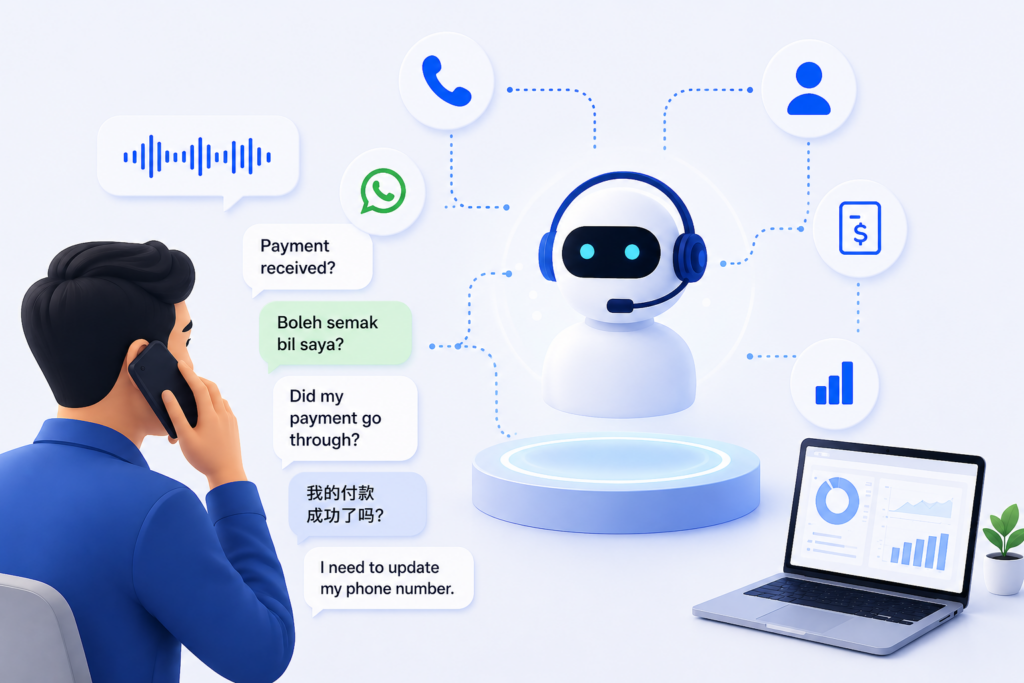
Malaysia’s linguistic diversity is one of the strongest reasons local enterprises benefit from AI voice agents. Many customers prefer to be served in the language they are most comfortable with — which varies by demographic, age, and region.
A multilingual AI voice agent detects the customer’s language from their opening sentence and continues in that language throughout the call. If a customer switches mid-conversation — saying “请讲华语” or “Boleh cakap Bahasa Malaysia?” — the AI adapts immediately.
This removes the language-matching pressure from your customer service team and ensures every customer is served comfortably, regardless of which language they prefer.
What AI Voice Agents Should Not Do
An AI voice agent is a powerful tool, but it should not be deployed without clear boundaries. For enterprise use, the AI must follow structured rules, not make free-form decisions.
The AI should not provide unsupported financial or legal advice. It should not reveal sensitive account information without completing identity verification. It should not attempt to handle complaints, fraud cases, or high-value relationship management — these must be escalated to a qualified human agent.
The value of an AI voice agent is not in replacing human judgement. It is in removing repetitive, structured, low-complexity tasks from your team’s workload so they can focus on the interactions that actually require a human.
Conclusion: AI Voice Agents Are Ready for Malaysian Enterprise Use
AI voice agents are no longer a future technology. They are deployable today, in Malaysia, across multiple industries, and the enterprises adopting them now are building a meaningful operational advantage over those still running entirely manual call centre operations.
The combination of multilingual support, live system integration, n8n workflow automation, and 24/7 availability makes AI voice agents one of the highest-ROI AI investments available to Malaysian businesses in 2025 and 2026.
If you want to see exactly how this looks in practice — including real implementation steps, technical architecture, and business results — read our companion article: AI Voice Agent Malaysia Case Study: How We Built It for a Finance Enterprise.
Want to Explore AI Voice Automation for Your Business?
Flow Digital is an AI automation agency based in Malaysia. We design and build enterprise AI voice agents, n8n workflow automation systems, WhatsApp chatbots, and full CRM and Odoo ERP integrations for businesses across Malaysia and Southeast Asia.
As an Odoo Official Partner, we have deep experience integrating AI automation directly into your business operations — not just connecting a voice bot to a phone number, but building AI into how your business actually runs.
👉 Visit www.flowdigital.my to book your free consultation. Let’s identify where AI voice automation can make the biggest difference for your business.
Frequently Asked Questions (FAQ)
01.What is the difference between an AI voice agent and a chatbot?
A chatbot communicates via text, typically on websites or messaging apps like WhatsApp. An AI voice agent communicates via voice over phone calls. Both use AI to understand customer intent, but the voice agent is designed for spoken interaction, multilingual conversation, and integration with telephone systems.
02.Can AI voice agents understand Malaysian accents and mixed-language speech?
Yes, when properly configured and tested. The speech-to-text engine must be trained on Malaysian accents and code-switching behaviour — mixing Bahasa Malaysia, English, and Mandarin. This testing phase is critical and should not be skipped.
03.Does an AI voice agent work 24 hours a day?
Yes. Unlike a human call centre, an AI voice agent operates continuously without shifts, overtime, or public holiday limitations. This is particularly valuable for outbound payment reminder campaigns and inbound enquiries outside office hours.
04.What is n8n and why is it used with AI voice agents?
n8n is a workflow automation tool that connects the AI voice agent to your existing business systems. After a call, n8n can automatically send a WhatsApp message, update a CRM record, create a support ticket, or notify a department. It supports on-premise deployment, making it suitable for organisations with data security and PDPA compliance requirements.
05.Is an AI voice agent suitable for small businesses or only large enterprises?
AI voice agents are most cost-effective for businesses handling a high volume of repetitive calls — typically 200 or more per day. Large enterprises benefit most from the scale, but mid-size businesses in finance, insurance, property, and healthcare can also see strong ROI, particularly from payment reminder automation and after-hours enquiry handling.
06.How is an AI voice agent different from a traditional IVR system?
A traditional IVR presents a menu and requires the customer to press a number. An AI voice agent understands natural language — the customer speaks normally and the AI interprets their intent. The experience is conversational rather than transactional, which significantly improves customer satisfaction and first-call resolution rates.