
How does an AI voice agent actually get built for a real Malaysian enterprise? What problems does it solve, how is it connected to existing systems, and what results does it produce?
This article shares a real implementation case study from Flow Digital — detailing how we designed, built, and deployed a full AI voice agent system for a Malaysia-based enterprise client in the financial services industry.
If you are a decision-maker in finance, insurance, property, healthcare, or any business running a high-volume customer service operation, this case study shows you exactly what is possible and what it takes to get there.
If you are new to AI voice agents and want to understand how the technology works before reading this case study, start here: What Is an AI Voice Agent and How Does It Work for Business in Malaysia.
The Client: A Malaysian Finance Enterprise With a Scaling Problem
Our client is a MNC financial services company operating across Malaysia. Like many enterprises in the sector, they were experiencing a set of operational challenges that were becoming increasingly expensive and difficult to manage.
The challenges they came to us with:
High call volume during billing cycles. Every month, a surge of customers called to check outstanding amounts, verify payment dates, and confirm payment receipt — creating predictable but severe peaks that overwhelmed the team.
Repetitive enquiries handled entirely manually. Customer service agents spent the majority of their day answering questions with near-identical answers, leaving little capacity for complex cases that genuinely needed a human.
Manual outbound payment reminder calls. The collections team manually dialled overdue accounts one by one — time-consuming, inconsistent, and impossible to scale during peak periods.
A multilingual customer base. Customers preferred English, Bahasa Malaysia, and Mandarin, creating a language-matching challenge across the team.
Inefficient call routing. Calls were frequently transferred between departments with incomplete context handovers, frustrating customers and wasting agent time.
Fragmented CRM data. Call outcomes were not consistently logged, reducing management visibility and making follow-up tracking unreliable.
No after-hours coverage. Customers who called outside business hours received no service at all — a lost opportunity and a poor customer experience.
The client did not want a basic voice menu system. They wanted an intelligent AI voice agent that could communicate naturally, follow real compliance and verification rules, and integrate meaningfully with their existing billing and CRM infrastructure.
What We Built: The AI Voice Agent Solution
Flow Digital designed a multi-functional AI voice agent handling both inbound customer service calls and outbound payment reminder campaigns — integrated with the client’s CRM, billing system, and n8n workflow automation layer.
The system was built to support four core use cases.
Use Case 1: Outbound AI Payment Reminder Calls
The highest-impact starting point was automating outbound payment reminders — a function previously handled entirely by the collections team.
The AI payment reminder workflow operates as follows:
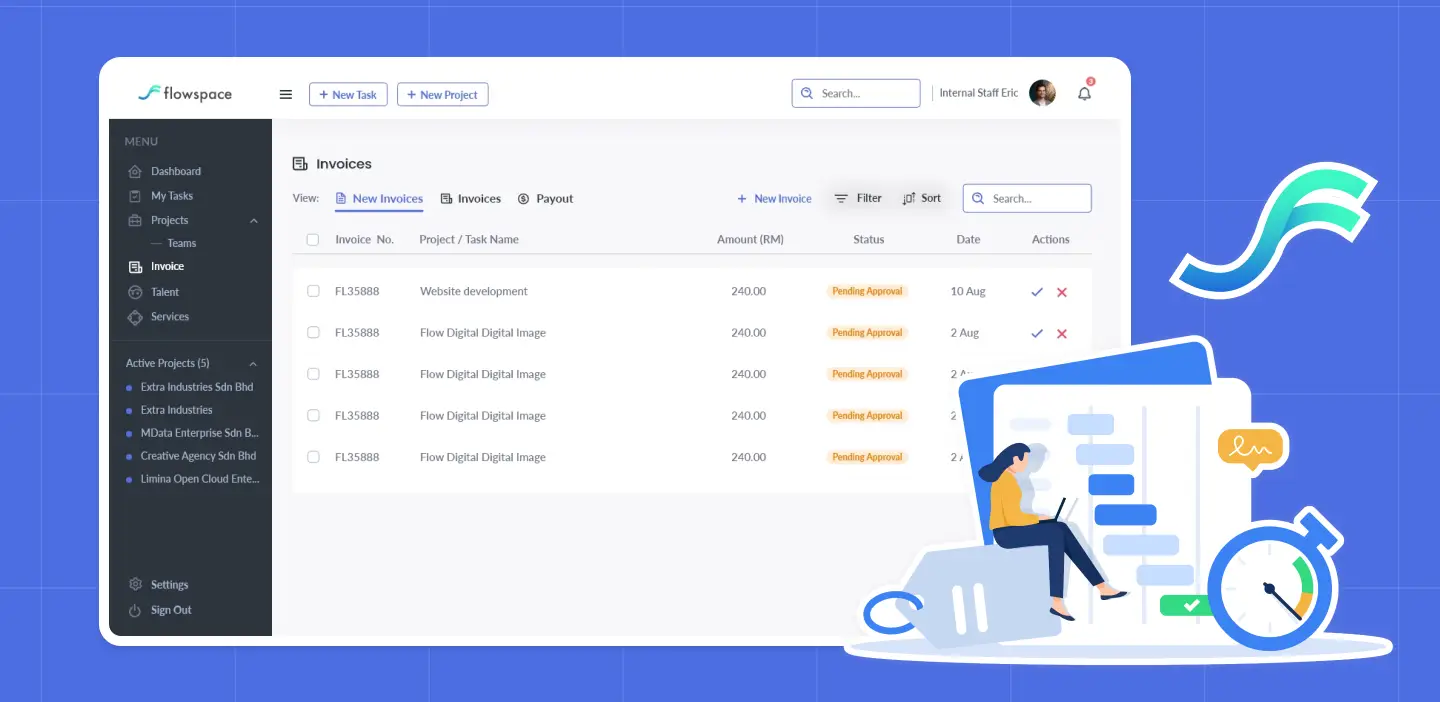
The billing system identifies customers with upcoming or overdue payments and syncs the list to the AI workflow. The AI voice agent calls each customer using a personalised, approved script. It confirms the customer’s identity through the required verification steps. It delivers the payment reminder including the exact outstanding amount and due date , and offers to send a payment link via WhatsApp or SMS. It records the customer’s response and intent. The n8n automation layer then executes the appropriate downstream action: sending the payment link, updating the CRM, creating an escalation ticket, or scheduling a callback for the billing team.
Human staff only intervene for escalated or genuinely complex cases.
Example outbound call script:
“Good afternoon. This is an automated call from the customer service team. May I confirm I am speaking with Encik Mohammad? For security purposes, may I verify the last four digits of your registered IC? Thank you. Your current outstanding amount is RM850 and your due date is 15 May. Would you like me to send the payment link to your registered mobile number?”
Automated voice reminders lift on-time payments by 20–30% compared to email-only follow-ups, and clients typically report up to 40% reduction in manual agent follow-up workload alongside lower cost per contact — results that closely matched what this client achieved.
Use Case 2: Inbound Billing Enquiry Automation
For inbound calls, billing enquiries were the highest-volume call type. Customers called to ask about outstanding amounts, due dates, payment confirmation, and statement requests.
The AI handles these calls automatically but only after completing a proper identity verification process. Depending on the client’s compliance policy, verification may include the customer’s registered mobile number, last four digits of NRIC, account number, or a one-time password.
After verification, the AI retrieves live billing data from the backend system and responds conversationally. Common questions handled include:
- “How much do I need to pay this month?”
- “Did you receive my payment?”
- “When is my next due date?”
- “Can you send me my statement?”
- “Why is my bill higher this month?”
Any question outside the AI’s approved scope is routed to the appropriate department rather than answered speculatively.
Use Case 3: Multilingual Customer Service
The AI voice agent was configured to support English, Bahasa Malaysia, and Mandarin — the three primary languages of the client’s customer base.
Language detection is automatic. The AI identifies the customer’s preferred language from their opening statement and serves the entire interaction in that language. If the customer switches mid-call — saying “请讲华语” or “Boleh cakap Bahasa Malaysia?” — the AI transitions immediately without requiring the customer to be transferred or repeat themselves.
The speech-to-text engine was tested against real Malaysian accents, local expressions, and code-switching patterns before deployment. Skipping this testing phase is one of the most common failure points in voice AI deployments — textbook language performance does not reflect how Malaysians actually speak.
Use Case 4: Intelligent Department Routing
When a customer’s enquiry exceeds the AI’s defined scope, the system routes the call to the correct department with a full context summary already prepared.
Routing logic used for this client:
- Billing dispute → Billing department
- Overdue payment negotiation → Collections team
- Technical issue → Support team
- Product enquiry → Sales team
- Formal complaint → Customer experience team
- Fraud or security concern → Risk and compliance team
The human agent receiving the call gets a structured summary: “Customer verified. Customer states payment was made via bank transfer on 10 April. Requests billing team to verify and call back. Preferred language: Mandarin.”
This approach ensures the customer is connected to a specialist without needing a second dial, eliminating the frustrating experience of being transferred and having to repeat everything from the beginning.
The Technical Stack
The system was built using the following architecture:
Telephony: Cloud telephony with SIP trunking and a dedicated Malaysian business number, integrated with WhatsApp Business API and SMS gateway for post-call follow-ups.
Speech-to-Text: A hybrid pipeline tuned for Malaysian English, Bahasa Malaysia, and Mandarin, achieving over 90% transcription accuracy with local accents and code-switching.
AI Conversation Engine: A fine-tuned large language model handling intent detection and response generation, constrained by the client’s approved business logic and knowledge base.
Knowledge Base: A locked repository of company-approved FAQ content, payment policies, service information, and compliance scripts — the AI answers only from this source.
CRM and Billing Integration: Secure REST API connections to the client’s billing platform and CRM, enabling real-time data retrieval during calls and automatic post-call updates.
n8n Workflow Automation: The downstream automation layer connecting the AI voice agent to WhatsApp Business API, ticketing system, internal dashboard, and management reporting. n8n was chosen for its flexibility and support for on-premise deployment, which was important for this client’s PDPA compliance requirements.
Text-to-Speech: A natural voice synthesis layer with under 300 milliseconds response latency, producing warm and professional audio output across all three languages.
Implementation Timeline
The project was delivered in structured phases over ten weeks.
Weeks 1–2 — Discovery and Workflow Mapping: We reviewed all existing call types, volumes, customer questions, routing rules, CRM structure, billing system APIs, compliance requirements, and language preferences. This defined exactly what the AI would and would not handle.
Weeks 3–4 — Conversation Design and Knowledge Base Preparation: We designed all conversation flows — greeting, identity verification, language selection, intent handling, error management, escalation logic, and closing — and prepared the approved knowledge base content with the client’s compliance team.
Weeks 5–6 — System Integration: We connected the AI agent to the billing system, CRM, WhatsApp Business API, SMS gateway, ticketing system, and n8n automation workflows.
Weeks 7–8 — Pilot Testing: We tested across a sample cohort of 1,500 accounts, covering English, Bahasa Malaysia, and Mandarin conversations, mixed-language interactions, failed verification scenarios, payment disputes, and human escalation cases.
Weeks 9–10 — Enterprise Rollout and Optimisation: Full deployment with live monitoring, performance tuning, and management dashboard setup.
Results: 90 Days After Full Deployment
Metric | Before | After |
Inbound calls handled autonomously by AI | 0% | 75% |
Average customer wait time | 4–6 minutes | Under 30 seconds |
On-time payment rate | Baseline | +27% improvement |
Manual outbound calling hours per week | 180+ hours | Under 30 hours |
After-hours customer enquiries resolved | 0% | 100% |
CRM call outcome update rate | Inconsistent | 100% automated |
Customer service operational cost | Baseline | Reduced by ~60% |
Human agents — freed from repetitive first-level calls — shifted their capacity to complex disputes, relationship management, and high-value customer cases. The collections team moved from manually calling hundreds of accounts weekly to reviewing AI call summaries and acting only on escalated cases.
Compliance and Data Security
For a finance industry client, compliance was non-negotiable throughout the project.
Every AI action is logged — call time, verification result, data retrieved, intent detected, action taken, department escalation, and call summary. This creates a full audit trail for regulatory review. The AI only accesses data within the scope of the active workflow. Customers are informed when calls are recorded in accordance with the company’s policy. The knowledge base is reviewed and locked — the AI cannot provide financial advice outside its approved scope. All data is encrypted in transit and at rest, with role-based access control throughout, in compliance with Malaysia’s Personal Data Protection Act (PDPA).
Conclusion: A Proven Blueprint for Malaysian Enterprise Voice Automation
This case study demonstrates that AI voice agents are not theoretical technology. They are production-ready, deployable in Malaysia today, and capable of delivering measurable operational and financial results within weeks of going live.
The finance client in this case study reduced their customer service operational cost by approximately 60%, improved on-time payment rates by 27%, and achieved 24/7 multilingual customer service coverage — without increasing headcount. Their human team is now more effective, better focused, and delivering higher value to the business.
The key to achieving this was not simply the AI technology. It was the combination of proper workflow design, identity verification and compliance controls, CRM and billing integration, multilingual testing, n8n automation, and continuous post-deployment optimisation.
If you want to understand the technology behind this — how each component works and what makes an AI voice agent different from a traditional IVR or chatbot — read our companion article: What Is an AI Voice Agent and How Does It Work for Business in Malaysia.
Ready to Build Your AI Voice Agent in Malaysia?
Flow Digital is an AI automation agency based in Malaysia. We design and implement enterprise AI voice agents, n8n workflow automation, WhatsApp chatbot solutions, CRM automation, and ERP integration for businesses across Malaysia and Southeast Asia.
What we offer:
- Free Consultation — We assess your current customer service workflow and identify your highest-impact AI automation opportunities at no cost
- Custom AI Voice Agent Design — Built for your industry, language requirements, compliance rules, and business logic
- Full System Integration — CRM, ERP, billing systems, WhatsApp Business API, AI tools, and more
- Real Malaysian Multilingual Testing — English, Bahasa Malaysia, Mandarin, and Tamil with local accent validation
- Ongoing Optimisation — Post-deployment monitoring, performance improvement, and capability expansion
Visit www.flowdigital.my to book your free consultation today.
Let’s build an AI voice agent that works for your business — 24 hours a day, in every language your customers speak.
Frequently Asked Questions (FAQ)
01.How long did it take to build and deploy the AI voice agent?
This enterprise deployment — including multilingual support, CRM and billing integration, AI workflow automation, pilot testing, and full rollout — took ten weeks from discovery to go-live. A simpler single-use-case pilot, such as payment reminder automation only, can be live in three to four weeks.
02.How does the AI verify customer identity before sharing billing information?
The AI follows the client’s approved verification protocol, which may include confirming the registered mobile number, last four digits of NRIC, account number, or a one-time password. If verification fails, the AI does not reveal any account details and directs the customer to the official hotline.
03.Can the AI handle situations where a customer is upset or refuses to cooperate?
Yes, within defined boundaries. If a customer becomes hostile, disputes an amount, or requests to speak to a human, the AI detects the intent and performs a warm transfer with a full context summary. The AI is designed to de-escalate gracefully and hand over smoothly — not to engage in conflict.
04.What happened to the human customer service team after deployment?
The team was not reduced. They were redeployed. Freed from handling repetitive Tier 1 enquiries, they focused on complex disputes, high-value relationship management, and customer experience improvement work that genuinely requires human judgement and creates more business value.
05.Can this be replicated for businesses outside the finance industry?
Yes. The same architecture applies to insurance, healthcare, property, education, retail, and telecommunications. The use cases change — appointment reminders instead of payment reminders, policy renewal calls instead of billing enquiries — but the technical approach and implementation methodology are consistent.
06.What role does AI Tool play in the system?
AI tool like n8n handles all downstream workflow actions triggered by AI call outcomes sending WhatsApp payment links, updating CRM records, creating support tickets, notifying departments, and generating management reports. It is the automation layer that connects the AI voice agent to the rest of the business operation.
07.Is this solution scalable as call volume grows?
Yes. Unlike a manual team, the AI voice agent scales without proportional cost increases. As call volume grows during billing cycles, campaigns, or business expansion, the AI handles the additional volume without additional headcount, shift management, or overtime cost.