Claude AI is not just another chatbot. It is the AI model that 70% of Fortune 100 companies have quietly embedded into their core business operations — and for good reason.
Built by Anthropic, Claude AI was designed from the ground up with one priority that most AI models treat as an afterthought: safety without sacrificing performance. While other large language models race to add features, Claude is engineered to be the AI your business can actually trust with sensitive documents, complex workflows, and mission-critical decisions.
But what exactly is Claude AI capable of? And more importantly, what does it mean for your business bottom line?
In this guide, we break down the core features of Claude AI, its real-world business applications across industries, and the honest challenges companies face when trying to deploy it at scale. Whether you are exploring AI for the first time or evaluating Claude against other tools, this is the complete picture you need before making any decisions.
What Is Claude AI? (And Why Businesses Are Paying Attention)
Claude AI is a large language model (LLM) developed by Anthropic, an AI safety company founded in 2021 by former members of OpenAI including Dario Amodei and Daniela Amodei. Unlike many AI models built primarily to maximise capability, Claude was architected with a method called Constitutional AI — a training framework that embeds ethical guidelines, transparency, and aligned behaviour directly into the model itself.
What does that mean for your business? It means Claude is less likely to generate harmful, misleading, or brand-damaging outputs. For organisations in finance, healthcare, legal, and enterprise services, that is not a nice-to-have — it is a hard requirement.
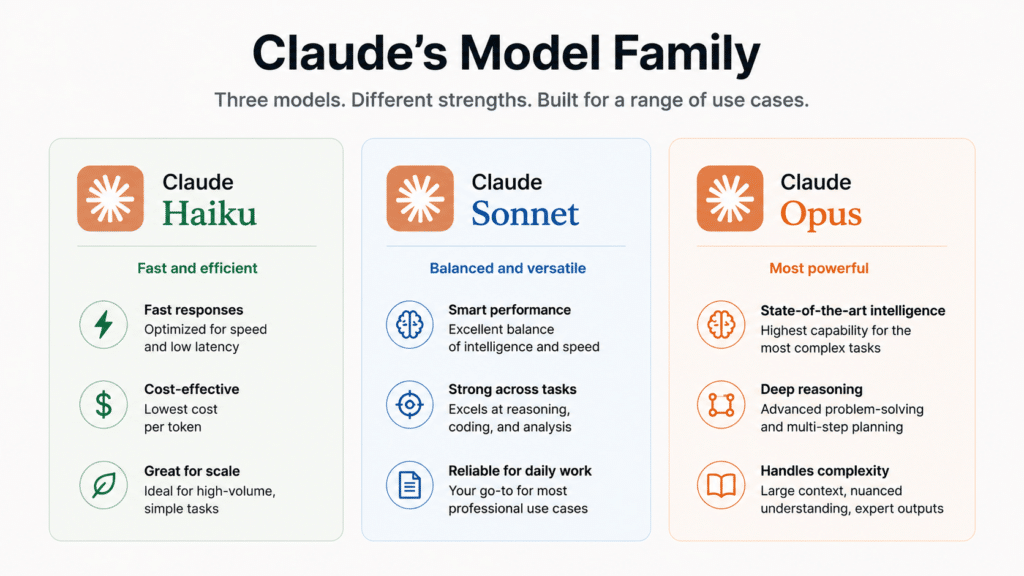
Claude AI has evolved rapidly since its beta launch in 2023. As of 2026, the model family includes Claude Haiku (speed-optimised, cost-efficient), Claude Sonnet (the world’s leading coding model with 77.2% on SWE-bench Verified), and Claude Opus (maximum intelligence for complex reasoning). Each tier is designed to serve distinct business needs at different price points.
The result? Enterprise adoption has accelerated sharply. According to Incremys’s 2025 Claude statistics report, 70% of Fortune 100 companies now use Claude, with large-scale deployments at organisations like Cognizant (350,000 staff) and Accenture (30,000 trained employees). This is no longer experimental technology. It is production-grade infrastructure.
Core Features of Claude AI You Need to Know
Understanding what Claude AI can technically do is the first step. Translating those capabilities into revenue outcomes is where the real business conversation begins.
200,000-Token Context Window
Most AI models struggle once a document exceeds a few pages. Claude AI processes up to 200,000 tokens in a single session — the equivalent of roughly 150,000 words, or a 500-page operational report.
In practice, that means your operations director can feed Claude an entire compliance audit, a full supplier contract, or a quarter’s worth of customer feedback transcripts and receive a precise, structured summary in under a minute. Tasks that used to take a senior analyst half a week now take less time than a coffee break.
Advanced Reasoning and Extended Thinking Mode
Claude AI features a hybrid reasoning engine. For routine tasks, it responds instantly. For complex, multi-layered problems — strategic analysis, financial modelling, legal document review — it can activate Extended Thinking Mode, where it methodically works through the problem step by step before delivering an output.
This is the difference between an AI that gives you a quick answer and one that gives you a defensible recommendation. For C-suite decision support, that distinction matters enormously.
Multimodal Input (Text, Documents, and Images)
Claude AI accepts text, PDFs, spreadsheets, images, and structured data as inputs. Your team can upload a scanned contract, a competitor’s brochure, or a financial statement and ask Claude to extract, compare, or synthesise information across all of them simultaneously.
For businesses running document-heavy operations — logistics, property, insurance, professional services — this alone can eliminate entire categories of manual work.
Claude AI Computer Use and Agentic Capabilities
Claude AI can now act, not just respond. Through its Computer Use and agentic capabilities, Claude can navigate software interfaces, complete multi-step workflows, interact with web-based tools, and execute tasks across connected systems autonomously.
Think of it this way: instead of an employee manually copying data from one platform to another, Claude can be configured to do that job 24 hours a day, seven days a week, without fatigue or error. This is what separates Claude AI from a productivity chatbot and positions it as an operational infrastructure layer.
Enterprise-Grade Security and Compliance
Claude AI meets SOC 2 Type II, HIPAA, and GDPR compliance standards. It is deployable via AWS Bedrock and Google Vertex AI, enabling enterprise teams to run Claude within their existing cloud governance frameworks — keeping data where it legally and contractually needs to be.
For businesses in regulated sectors or those handling sensitive customer data, this compliance architecture is the prerequisite that makes deployment viable at all.
Claude AI Business Applications Across Industries
The following are not theoretical use cases. These are workflows that businesses are actively running on Claude AI today — with measurable productivity and revenue outcomes.
Marketing and Content Operations
A 2025 HubSpot survey found that marketers using AI assistants produced 3.5 times more content per week while maintaining quality scores within 8% of human-only baselines. Claude AI is particularly strong here because it can ingest your brand guidelines, tone-of-voice documents, and past campaigns — and then produce on-brand SEO blog drafts, email sequences, ad copy, and social content at scale.
The business outcome is not just speed. It is the ability to cover more keywords, more channels, and more audience segments without expanding your marketing headcount. For growing businesses competing in crowded digital markets, that is a compounding competitive advantage.
Sales Enablement and Prospect Research
According to Salesforce’s 2025 State of Sales report, the average sales representative spends only 28% of their working week actually selling. The remaining 72% goes to admin, manual research, and documentation.
Claude AI attacks that 72% directly. Feed it a prospect’s website, recent press releases, and LinkedIn profiles of key stakeholders, and it produces a structured briefing document with pain points, recent initiatives, and conversation starters — in minutes. It can also draft personalised follow-up emails, update CRM entries, and generate sales proposal frameworks, freeing your team to spend more time in front of buyers.
Customer Support Automation
Claude AI can be integrated into your customer support infrastructure to handle Tier 1 and Tier 2 inquiries around the clock — answering product questions, troubleshooting common issues, processing routine requests, and escalating complex cases to human agents with full context already compiled.
The business outcome is a measurable reduction in average handle time, cost per ticket, and customer wait times — while maintaining the nuanced, empathetic tone that customers expect.
Software Development and Code Review
Claude Sonnet currently ranks as the world’s best coding model, scoring 77.2% on the SWE-bench Verified benchmark. For development teams, this translates to measurable sprint acceleration. Claude AI can scaffold new components, write unit tests, review pull requests for logic errors, suggest performance optimisations, and refactor legacy code with long-context awareness across an entire codebase.
The business outcome for technology companies and digital product teams is shorter development cycles, fewer bugs reaching production, and senior developers freed from repetitive review work to focus on architecture and innovation.
Document Analysis and Internal Knowledge Management
Most organisations are drowning in unstructured data: policy documents, client contracts, internal SOPs, compliance reports, and meeting transcripts. Claude AI can ingest, index, and surface insights from all of this content — turning a static knowledge base into a dynamic, queryable asset.
Ask Claude to compare two vendor contracts for risk clauses. Ask it to extract all payment terms from a batch of supplier agreements. Ask it to summarise six months of customer call transcripts into a prioritised list of product feedback. Every one of these tasks that previously required hours of human time now takes seconds. For more on how AI is transforming business operations, read our post on AI Workflow Automation vs Traditional Automation.
Finance and Operations Reporting
Finance teams routinely spend days compiling weekly and monthly management reports — pulling data from multiple systems, reconciling figures, and formatting outputs for different stakeholders. Claude AI can be connected to your data sources to automate this entire process: pulling variance analysis, generating narrative commentary on financial performance, flagging anomalies, and producing board-ready summaries on a scheduled basis.
The business outcome is finance directors who spend their time on strategic decisions rather than spreadsheet assembly — and a significant reduction in the human error risk that comes with repetitive manual data processing.
HR and Recruitment Workflow Automation
Recruitment is one of the most document-intensive functions in any business. From CV screening and interview scheduling to onboarding documentation and policy communications, HR teams spend a disproportionate amount of time on process rather than people.
Claude AI can screen CVs against structured job criteria, generate interview question sets tailored to specific roles, draft onboarding emails, and serve as an internal HR policy assistant that answers employee questions instantly and accurately. The result is an HR function that scales with headcount growth without requiring proportional increases in HR staffing — a critical efficiency for fast-growing businesses.
The Real Challenge: Implementing Claude AI in Your Business
Here is the conversation most AI vendors skip: the gap between what Claude AI can do and what your business will actually get from it — without the right implementation architecture — is significant.
Claude AI’s capabilities are real and well-documented. But deploying them effectively inside a live business environment requires solving a set of compounding technical and operational challenges that are rarely discussed in product demos.
Prompt drift is one of the first issues businesses encounter. A workflow that produces excellent outputs in testing begins to degrade over weeks as operational inputs change, edge cases accumulate, and prompts that were not designed for robustness start producing inconsistent results.
API integration failures are another common obstacle. Connecting Claude AI to your CRM, ERP, customer support platform, or internal databases requires well-structured middleware, error handling, and failover protocols. Without these, a single upstream system change can break your entire automation stack.
Data privacy guardrails require careful architectural decisions. Passing sensitive customer data or proprietary business information through an AI model creates compliance obligations that must be designed for explicitly — not retrofitted after deployment.
Ongoing maintenance is the hidden cost that most internal teams underestimate. AI workflows require continuous monitoring, prompt updates, performance testing, and version management as the underlying models are updated. Without a dedicated owner, the ROI of your Claude investment erodes quickly.
The businesses that scale Claude AI successfully are not the ones with the largest IT teams. They are the ones that partner with specialists who have built and maintained these workflows in production environments. This is exactly where Flow Digital’s AI automation services are designed to remove the friction and accelerate the return.
The Bottom Line on Claude AI
Claude AI is not a productivity experiment. It is a production-grade business infrastructure that is already reshaping how the world’s most competitive organisations operate — from how they process documents and serve customers, to how they build software and manage their people.
The businesses winning with Claude AI in 2026 are not necessarily the largest or the most technically sophisticated. They are the ones that moved from evaluation to execution — and did it with the right architecture in place from day one.
The capabilities are proven. The ROI is documented. The only question left is whether your business captures that advantage before your competitors do.
If you are ready to move from curiosity to competitive edge, the next step is a conversation with a team that has already built what you are trying to achieve.
Ready to Put Claude AI to Work in Your Business?
Most businesses spend months evaluating AI tools and never close the gap between potential and production. The ones that move fast and see results are the ones that partner with a team that has already solved the implementation challenges they are about to face.
At Flow Digital, we have built and deployed Claude AI workflows for businesses across marketing, operations, customer service, and software development. We do not sell AI licenses. We design the architecture that makes those licenses generate measurable business outcomes.
Our AI automation service covers the full deployment lifecycle: workflow scoping and design, API integration with your existing systems, prompt engineering and testing, data privacy structuring, and ongoing monitoring and optimisation. We handle the technical complexity so your team can focus on using the outputs — not troubleshooting the infrastructure.
If you are ready to move beyond experimentation and deploy Claude AI in a way that actually scales, let’s talk to our AI Automation Team.
Frequently Asked Questions (FAQ)
01.What is Claude AI used for in business?
Claude AI is used across a wide range of business functions including content creation, customer support automation, sales research, document analysis, software development, HR workflow automation, and finance reporting. Its large context window and agentic capabilities make it particularly powerful for workflows involving long documents, multi-step processes, and cross-system data handling.
02.Is Claude AI better than ChatGPT for enterprise use?
Both are capable enterprise tools, but Claude AI is generally preferred for use cases requiring long-document processing, higher output safety, and compliance-sensitive deployments. Claude’s 200,000-token context window, Constitutional AI training, and enterprise security certifications (SOC 2 Type II, HIPAA) make it the stronger choice for regulated industries and complex operational workflows.
03.How does Claude AI handle data privacy and security?
Claude AI meets SOC 2 Type II and HIPAA compliance standards. Enterprise deployments can be hosted on AWS Bedrock or Google Vertex AI, allowing organisations to run Claude within their existing data governance frameworks. Proper implementation architecture — including data handling protocols and access controls — is essential to ensure full compliance.
04.Can Claude AI integrate with our existing business systems?
Yes. Claude AI connects to existing systems via API, enabling integration with CRMs, ERPs, customer support platforms, data warehouses, and custom internal tools. The complexity of integration depends on your existing technology stack. Working with an experienced AI automation partner significantly reduces integration risk and deployment time.
05.What is the difference between Claude Haiku, Sonnet, and Opus?
Claude Haiku is optimised for speed and high-volume, cost-sensitive tasks. Claude Sonnet is the current world-leading coding model and the best all-round choice for most business workflows. Claude Opus delivers maximum intelligence for highly complex reasoning tasks such as strategic analysis and advanced research. The right tier depends on your specific use case and volume requirements.
06.Is Claude AI available for Malaysian businesses?
Yes. Claude AI is globally available via the Anthropic API and through AWS Bedrock and Google Vertex AI. Malaysian businesses can deploy Claude AI for their operations today. Flow Digital provides localised AI automation implementation services for businesses across Malaysia looking to deploy Claude at scale.
07.How is Claude AI different from a basic chatbot?
A basic chatbot follows a fixed decision tree and can only handle pre-programmed scenarios. Claude AI understands context, handles nuance, processes long documents, and adapts responses dynamically. Businesses that have replaced rule-based chatbots with Claude AI consistently report higher resolution rates and lower escalation volumes.
08.Can I build a custom Claude AI agent for my business?
Absolutely. Claude AI’s API allows fully custom agent design tailored to your specific workflows, data sources, and business logic — from procurement assistants to compliance review agents to internal knowledge bots. Flow Digital specialises in custom Claude AI agent development from scoping through to live deployment. Start the conversation here.
09.How do I identify the best Claude AI workflows for my business?
The highest-ROI workflows are those with the highest volume of repetitive human effort and a clear measurable output — document processing time, cost per support ticket, content production speed, or sales research hours. Flow Digital offers a structured AI workflow audit as part of our onboarding process to prioritise automations with the strongest and fastest return.
10.How do we get started with Claude AI in Malaysia?
The fastest starting point is a discovery call with Flow Digital’s AI automation team. We will review your workflows, identify the highest-value automation opportunities, and propose a deployment roadmap scoped to your budget and timeline. Malaysian businesses have full access to Claude AI’s enterprise capabilities — with Flow Digital as your local implementation partner. Book your discovery call today.