


AI can improve productivity, automate customer service, accelerate content creation, and reduce repetitive work. But as Malaysian businesses integrate AI deeper into daily operations, another problem can emerge: AI usage costs start increasing faster than expected.
The instinctive response is often to restrict AI usage, shorten every response, or move everything to a cheaper model. While these measures may reduce the bill, they can also reduce output quality and undermine the reason the business adopted AI in the first place.
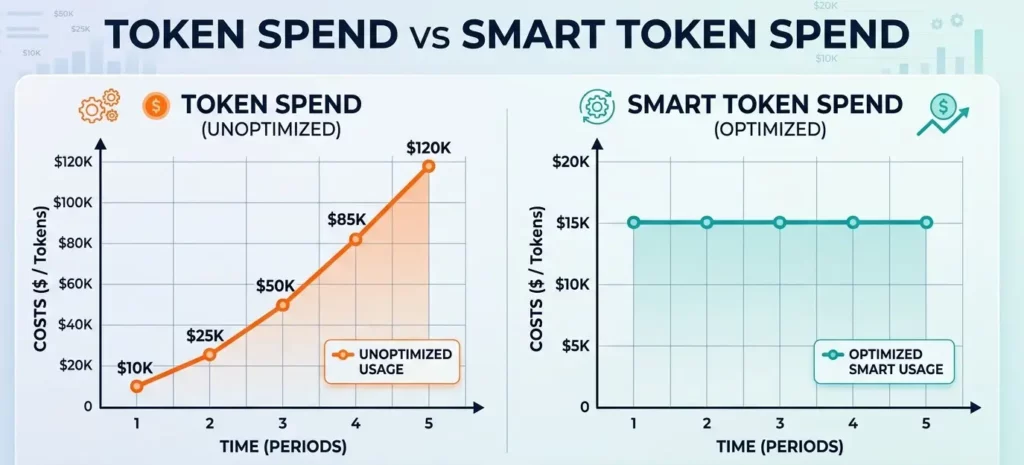
The better approach is to improve AI token efficiency. Tokens are the units AI models use to process inputs and generate outputs, and token-based API costs can vary according to the model, input volume, output volume, cached input, and other processing requirements. Inefficient prompts, unnecessary conversation history, oversized knowledge bases, and premium models being used for simple tasks can all increase operating costs without creating proportional business value.
This matters increasingly in Malaysia. As adoption grows, businesses will need to think beyond simply implementing AI and start managing how efficiently their AI systems operate. In this article, we explore seven practical ways businesses can reduce unnecessary AI token usage while maintaining performance, accuracy, and scalability.
What Is AI Token Usage and Why Does It Matter for Businesses?
A token is a small unit of text that AI models process when reading prompts and generating responses. Longer prompts, repeated instructions, unnecessary conversation history, and excessive background information can all increase AI operating costs. While each interaction may seem inexpensive, these inefficiencies can add up quickly when AI is used across customer service, content, sales, or internal workflows.
AI adoption in Malaysia is also accelerating. According to a report by Amazon Web Services (AWS), around 27% of Malaysian businesses have adopted AI tools, representing approximately 2.4 million businesses, with adoption growing 35% year on year. As more SMEs integrate AI into daily operations, managing token usage efficiently will become increasingly important for controlling costs and protecting ROI. The goal is not simply to use fewer tokens, but to make sure the AI processes only the information needed for each task. For a deeper explanation, read our guide on how AI context windows affect performance.
1. Trim and Standardize Your Prompts
One of the simplest ways to reduce unnecessary AI token usage is to review what your team sends to the model. Repeated instructions, unnecessary background information, excessive examples, and filler can increase input token usage without meaningfully improving the output.
Businesses can develop concise, reusable prompt templates that contain only the information required for the task.
- Remove repeated instructions: State requirements once instead of reinforcing the same point several times.
- Standardise common prompts: Create reusable templates for recurring tasks such as product descriptions, customer replies, reports, or content drafts.
- Keep only relevant context: Include background information only when it directly influences the expected output.
- Review prompts based on performance: Test shorter versions and confirm that output quality remains consistent before implementing them across the team.
For example, a retail business using AI to generate product descriptions may repeatedly provide the same brand voice, audience, structure, and formatting requirements. Standardising these instructions into a clear reusable template can reduce unnecessary repetition across hundreds of requests while improving consistency between team members.
The goal is not to make every prompt as short as possible. It is to ensure every instruction earns its place by contributing to the quality, accuracy, or usefulness of the AI response.
2.Optimise Context Instead of Re-Sending Everything
AI workflows often process repeated information such as brand guidelines, customer history, product details, policies, or previous conversations. If all of this context is sent with every request, businesses may consume more tokens than necessary.
Instead, businesses should provide only the information relevant to the current task and use approaches such as prompt caching, conversation summaries, or selective retrieval where appropriate.
- Summarise long conversation histories: Keep the important details without passing the entire conversation repeatedly.
- Retrieve only relevant information: Avoid sending a full product catalogue or knowledge base when only one section is needed.
- Reuse repeated instructions efficiently: Use prompt caching or structured system instructions where supported.
- Remove outdated context: Old or irrelevant information adds cost and may also reduce response accuracy.
For example, a customer asking about one product does not require the AI to process information about every product your business sells. Providing only the relevant product details can reduce unnecessary processing while keeping the response accurate. The goal is to give the AI enough context to perform well, without making it process information that has no impact on the task.
3. Match the AI Model to the Complexity of the Task
Not every task requires the most advanced or expensive AI model. Using a premium reasoning model for simple, repetitive work can increase operating costs without delivering meaningful improvements in output quality.
Businesses should match the model or automation method to the complexity of the task:
- Simple FAQs and routine replies: Use templates, rules-based automation, or lightweight models.
- Basic summarisation and classification: Use cost-efficient models where appropriate.
- Complex analysis or strategy: Reserve more capable models for tasks that genuinely require deeper reasoning.
- High-risk or sensitive decisions: Use stronger models together with human review.
For example, a customer asking about business hours does not require the same model capability as a customer requesting a complex product recommendation. Routing each task to the appropriate model helps businesses control AI costs while maintaining the level of performance each use case actually needs. The objective is not to use the cheapest model for every task, but to avoid paying for advanced capability when the business problem does not require it.
4. Automate Repetitive Conversations Instead of Running Them Through AI Manually
Not every customer interaction requires AI. Routine enquiries such as business hours, order status, appointment confirmations, delivery updates, or payment reminders can often be handled more efficiently through predefined responses and workflow automation.
Businesses can use an automation-first, AI-when-needed approach:
- Repetitive enquiries: Use predefined responses or rules-based automation.
- System-based requests: Retrieve information directly from CRM, ERP, booking, or order systems.
- Complex enquiries: Use AI when interpretation or personalised responses are required.
- Uncertain or sensitive cases: Escalate the conversation to a human employee.
For example, instead of using AI to generate a new response every time a customer asks about delivery status, automation can retrieve the latest order information and send an approved response automatically. AI is then reserved for enquiries that genuinely require natural-language understanding or judgement. This helps businesses reduce unnecessary AI calls and token usage while maintaining fast and consistent customer service.
5. Set Limits and Monitor AI Usage Like a Business Budget
Most SMEs track ad spend closely but let AI usage run unmonitored until the bill arrives. Treat token usage the same way you’d treat any other line item.
- Set monthly usage caps per tool or team
- Review usage reports at least once a month
- Flag sudden spikes early instead of discovering them at billing time
Businesses that build this habit early avoid the common trap of AI spend quietly outpacing the value it delivers.A simple starting point to reduce AI token usage without adding headcount: assign one person, even part-time, to glance at usage dashboards every two weeks. Most AI platforms already provide this data. The habit isn’t complicated. It’s just often skipped, because AI usage doesn’t feel like a “real” expense the way rent or payroll does, until the invoice proves otherwise.
6. Clean and Optimise Your AI Knowledge Base
AI systems often rely on knowledge bases containing product information, FAQs, policies, SOPs, and other business documents. When this information becomes outdated, duplicated, or unnecessarily large, the system may retrieve and process more content than needed, increasing token usage while potentially reducing response accuracy.
Businesses should regularly maintain their AI knowledge base by:
- Removing duplicate content: Keep one authoritative version of important information.
- Archiving outdated information: Remove expired pricing, promotions, policies, and product details.
- Structuring information clearly: Organise content so the system can retrieve relevant information efficiently.
- Retrieving only what is needed: Avoid sending entire documents when only a small section is relevant to the request.
A cleaner knowledge base helps AI retrieve the right information with less unnecessary context, supporting both lower token consumption and more accurate responses.
7. Optimise the Entire AI Workflow not Just Token Usage
Reducing token usage is not only about shortening prompts. As businesses scale AI across customer service, sales, marketing, and internal operations, unnecessary model calls, inefficient integrations, and poorly designed workflows can also increase costs.
Businesses should review the entire AI workflow by:
- Identifying unnecessary AI calls: Use AI only where interpretation, reasoning, or generation is required.
- Choosing the right model: Route simple and complex tasks to appropriate models.
- Optimising system integrations: Reduce unnecessary data transfers and repeated processing.
- Monitoring performance continuously: Review AI costs and workflow efficiency as usage grows.
Flow Digital can help businesses audit existing AI workflows, identify unnecessary processing, and design more cost-efficient automation around their actual operations. The goal is not simply to minimise tokens, but to build an AI automation system that delivers stronger business value for every dollar spent.
Smarter AI Usage Means Lower Costs, Not Lower Quality
Reducing AI token usage does not mean limiting what AI can do for your business. The goal is to eliminate unnecessary processing by using clearer prompts, optimising context, choosing the right model, automating predictable tasks, maintaining a clean knowledge base, and continuously monitoring usage.
As AI becomes more deeply integrated into daily business operations, cost efficiency will become increasingly important. Businesses that optimise their AI workflows can control operating costs while maintaining response quality, productivity, and scalability. Ultimately, the focus should not be on using the fewest tokens possible, but on generating greater business value from every AI interaction.
Build More Cost-Efficient AI Workflows with Flow Digital
If your AI costs are increasing and you are unsure where the unnecessary usage is coming from, Flow Digital can help. We assess your existing AI workflows, identify inefficient model calls and processes, and determine where AI, workflow automation, system integration, or simpler rules-based automation can deliver better results.
Instead of simply reducing AI usage, we help you build a more efficient automation system designed around your actual business needs, so you can control AI costs, improve operational efficiency, and scale without unnecessary technology spending.
Talk to Flow Digital to discover how we can help optimise your AI workflows for better long-term ROI.
Frequently Asked Questions (FAQ)
01.What is token usage in AI and why does it matter for businesses?
Tokens are the units AI models use to process text, and you’re billed per token. High or wasteful token usage directly increases your monthly AI costs, especially for businesses running frequent customer interactions
02.Why does AI token usage affect business costs?
Many AI platforms and APIs charge based on the number of tokens processed. As usage grows across customer service, content, sales, and internal workflows, inefficient token usage can increase monthly operating costs significantly.
03.How can I reduce AI token usage without losing response quality?
Businesses can reduce unnecessary token usage by trimming prompts, removing repeated context, using the right model for each task, automating predictable workflows, maintaining a clean knowledge base, and monitoring usage regularly.
04.Does reducing token usage affect the accuracy of AI responses?
Not if done correctly. Cutting filler and redundant context actually improves clarity. Flow Digital designs AI workflows that stay accurate while trimming unnecessary token spend.
05.What's the difference between token usage and API cost?
Token usage is the volume of text processed. API cost is what you pay based on that volume and the model used. Fewer, smarter tokens directly lower your API bill.
06.Is it worth hiring an AI automation agency to manage token usage?
It can be worthwhile when your business is using AI across multiple workflows, models, or systems and costs are becoming difficult to control internally. An experienced AI automation agency can review prompt design, model selection, context handling, system integrations, and unnecessary AI calls to identify where usage can be made more efficient.
Flow Digital can help audit your existing AI workflows and recommend a more cost-efficient setup based on your actual business processes. The goal is not simply to reduce token usage, but to improve overall AI ROI while maintaining performance, accuracy, and scalability.
07.What is the difference between reducing token usage and optimising AI workflows?
Reducing token usage focuses on cutting unnecessary processing. AI workflow optimisation takes a broader view by improving prompts, model selection, automation logic, system integrations, knowledge retrieval, and human handover to improve overall ROI.
08.What tools help monitor AI token consumption?
Most AI platforms provide usage dashboards. Pairing these with monthly budget reviews helps businesses catch spikes before they become expensive habits.
09.How often should businesses review AI usage and costs?
Businesses should review AI usage regularly, especially as new teams, workflows, and use cases are added. Monitoring costs by model, workflow, and business outcome can help identify inefficiencies before they become expensive.
10.Can Flow Digital help optimise an existing AI setup?
Yes. Flow Digital can review existing AI workflows, identify unnecessary model calls, inefficient context usage, and automation gaps, then recommend improvements based on your business processes. The objective is to reduce avoidable AI costs while maintaining performance, scalability, and business value.