

Malaysian businesses are facing a financial pressure that isn’t going away anytime soon. Labor costs are climbing, regulatory requirements are tightening, and the operational model that worked three years ago is beginning to crack. For SMEs in particular, the question is no longer whether to act. It’s how quickly they can adapt before shrinking margins force their hand.
Automation has emerged as one of the most talked-about responses to this challenge. But like most business decisions, the reality is more nuanced than the sales pitch suggests. Automation is not a switch you flip. It’s a strategic investment. Done well, it frees your team to focus on higher-value work. Done poorly, it creates new problems while leaving the old ones in place.
This article breaks down why labor costs are rising, what the real business impact looks like, and how automation can and cannot help.
Why Labor Costs Are Rising Faster Than Ever
The numbers are difficult to ignore. Malaysia’s national minimum wage increased from RM1,500 to RM1,700 per month under the Minimum Wages Order 2024, rolled out in two phases starting February 2025, with full implementation across all employers by August 2025. This marks the third increase since 2020, reflecting a clear government direction: wages in Malaysia will continue to move upward.
Minimum wage legislation is just one layer. Beyond the floor rate, businesses are absorbing higher EPF contributions, rising SOCSO obligations, and increasing employee expectations around flexibility, benefits, and work-life balance, particularly post-pandemic. Industries like F&B, retail, logistics, and manufacturing face additional pressure from high turnover rates and a persistent shortage of both skilled and entry-level workers.
Global inflationary trends compound the issue further. The International Labour Organization (ILO) has consistently highlighted wage growth as a priority across Southeast Asia, and Malaysia’s trajectory aligns with this regional direction. The expectation that wages will stabilise in the near term is not realistic. Businesses that build their financial models on current wage levels without accounting for further increases are planning for a version of the future that is unlikely to materialise.
The Real Impact of Rising Labor Costs on Businesses
Higher wages are not just a payroll issue. They ripple across the entire operating model.
Shrinking profit margins are the most immediate consequence. For businesses running on thin margins, particularly in F&B, retail, and distribution, a 13% increase in the minimum wage is not simply absorbed. It either gets passed to customers, absorbed from profit, or triggers a rethink of staffing models.
Reduced scalability is a subtler problem but arguably more damaging over time. When growth requires hiring and each hire carries a higher fixed cost, expansion becomes financially riskier. Businesses become reluctant to take on new clients, new locations, or new product lines because the cost structure doesn’t support it.
Operational inefficiencies tend to accumulate quietly. When labor is inexpensive, it’s easy to tolerate processes that could be better designed. Manual data entry, repetitive approvals, paper-based workflows, and duplicate reporting persist because it’s simpler to assign a person to the task than to redesign the process. Rising labor costs change that calculation.
Increased manual dependency creates fragility. When a key person leaves, their institutional knowledge goes with them. Processes that live in someone’s head rather than in a documented, repeatable system are a liability. Automation forces businesses to document and structure their workflows, which has operational benefits beyond cost alone.
What Business Automation Really Means Today
Automation in a business context is often misunderstood. It doesn’t necessarily mean robots on a factory floor or expensive enterprise software that takes years to implement. For most Malaysian SMEs, automation means using software and integrated systems to handle tasks that previously required manual human effort.
There are three categories that matter most for small and growing businesses:
Workflow automation covers task management, approval routing, deadline tracking, and internal notifications. Instead of someone manually chasing a teammate for a sign-off, the system routes the request, sends reminders, and records the outcome automatically.
Customer management (CRM) includes lead tracking, follow-up sequencing, deal pipeline visibility, and customer communication history. A CRM replaces the spreadsheet-and-memory approach that most SMEs rely on, which consistently produces missed follow-ups and inconsistent customer experiences.
Financial automation handles invoicing, payment collection, expense categorisation, and payroll processing. These are high-frequency, rule-based tasks where errors carry a real cost, and they tend to consume disproportionate time in lean teams.
It’s worth distinguishing automation from AI and outsourcing, since these terms are often conflated. Automation follows predefined rules: if this happens, do that. AI introduces judgment and pattern recognition into processes. Outsourcing moves work to a third party rather than a system. All three can reduce labor dependency, but they involve different levels of investment, control, and risk.
How Automation Helps Reduce Labor Dependency
The most direct way automation addresses rising labor costs is by reducing the volume of manual work required to run operations at the same level.
Minimising repetitive manual tasks is where most businesses find the fastest return. Data entry, report generation, invoice creation, and meeting scheduling are rule-based, time-consuming, and prone to human error. Automating them doesn’t eliminate jobs, but it changes what those jobs look like.
Improving accuracy has a financial value that’s often underestimated. Manual processes introduce error at a predictable rate. A missed invoice, an incorrect data entry, or a delayed follow-up each costs real money. Automated processes don’t get tired, distracted, or inconsistent. According to McKinsey’s 2024 Global AI Survey, organisations implementing automation at scale report average cost reductions of 20 to 30% in targeted business processes.
Enabling smaller teams to handle larger workloads is the scalability benefit that makes automation financially compelling. A team of five running on well-designed automated workflows can often handle the operational volume that previously required eight or ten people. This doesn’t mean headcount reduction has to be the goal. It means that growth no longer requires proportional hiring.
Supporting remote and hybrid operations has become increasingly relevant. Distributed teams need systems that work without physical oversight. Automation provides the structure and visibility that makes remote work operationally sustainable.
Key Areas Where Automation Delivers Immediate ROI
Not every part of a business is equally ready for automation. The highest-impact areas tend to share a common characteristic: they are high-frequency, rule-based, and currently managed manually.
Sales and CRM management is consistently the area where SMEs see the fastest payback. Missed follow-ups, inconsistent pipelines, and lost deals from poor handover are common problems that a structured CRM solves directly. Tools like Flowhubr provide a centralised system to manage contacts, track deals, and automate follow-up sequences without the complexity of enterprise CRM platforms.
Project and task tracking removes the need for managers to manually check on progress. When tasks are assigned in a system with due dates, dependencies, and status tracking, the team spends less time reporting and more time doing. This is especially valuable for businesses running multiple client projects simultaneously.
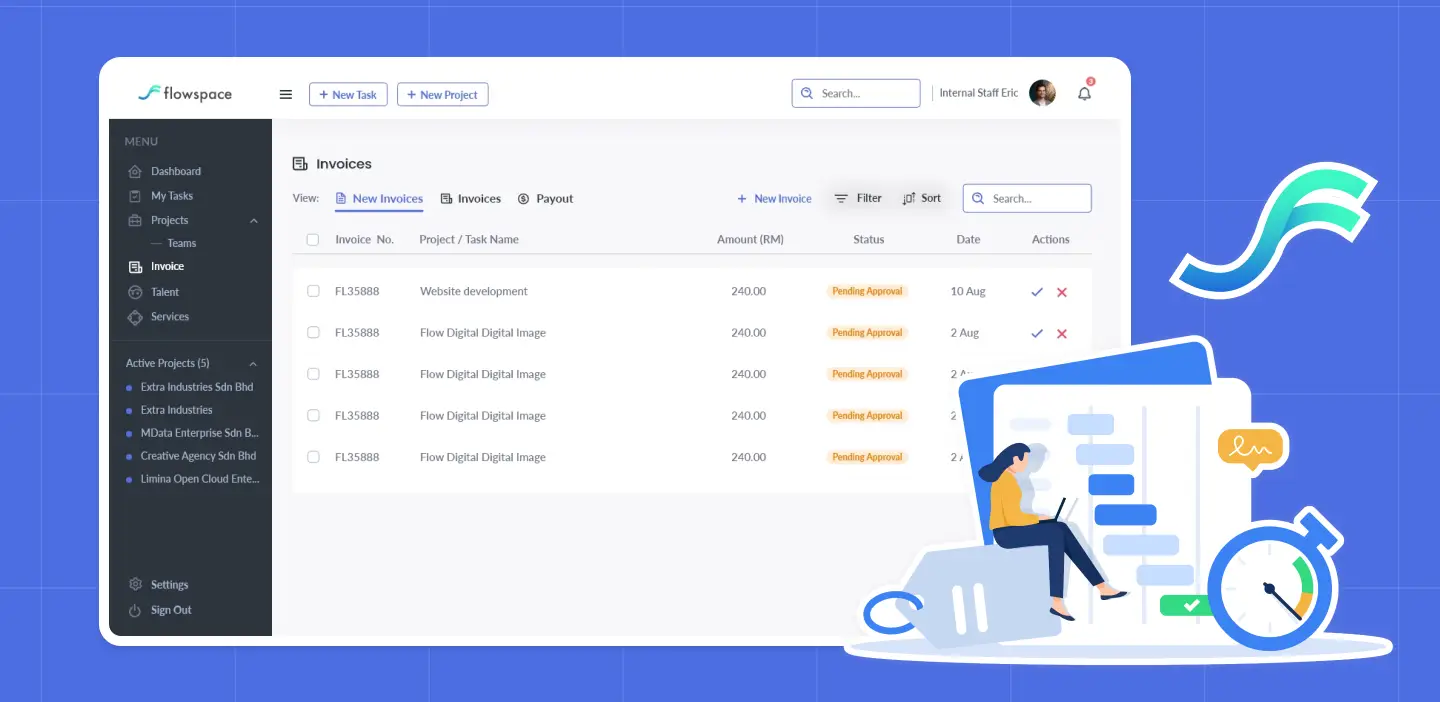
Invoicing and payment collection is one of the clearest automation wins available. Recurring invoices, payment reminders, overdue notifications, and reconciliation can all be handled systematically. Cash flow predictability improves, and finance teams spend less time chasing payments.
Customer support and communication benefits from automation at the routing and acknowledgment layer. Automated acknowledgment emails, ticket routing, FAQ responses, and escalation triggers reduce the manual effort required to maintain responsive customer service.
Internal reporting and analytics can shift from a weekly manual exercise to a live dashboard. When data flows automatically into a reporting system, decision-makers have access to current information rather than last week’s compiled spreadsheet.
If you’re still figuring out where to start, the Flow Digital guide on how to identify automation opportunities inside your business provides a practical framework for mapping your workflows and spotting the highest-impact areas before committing to any tool.
Is Automation Right for Every Business?
The honest answer is: not always, not immediately, and not everywhere.
When automation makes sense is when tasks are repetitive, rule-based, high-volume, and currently creating bottlenecks or errors. If a process changes frequently, requires significant human judgment, or only happens occasionally, the automation return is lower.
Common misconceptions about automation costs create hesitation that is sometimes justified and sometimes not. Many business owners assume automation requires large upfront investment and months of implementation. Modern cloud-based tools have changed this significantly. The barrier to entry for workflow and CRM automation is now within reach for SMEs, and the payback period is often measured in weeks rather than years.
The implementation and change management challenge is real. Technology adoption fails more often because of people than because of tools. Teams need to understand why processes are changing, how the new system works, and what it means for their daily roles. Skipping this investment typically leads to underutilisation, workarounds, and eventual abandonment of the system.
Balancing human workforce with technology remains the core tension. Automation performs best on work that shouldn’t require human judgment in the first place. The goal is not to replace people. It’s to redirect their time toward work that genuinely benefits from human thinking, creativity, and relationships.
Adapt Early, Compete Better
Rising labor costs are not a temporary condition. They reflect structural shifts in Malaysia’s labor market, regulatory environment, and employee expectations. Businesses that continue to operate on manual, labor-intensive processes will face compounding pressure as those costs increase, while competitors who have invested in operational efficiency are able to scale faster, serve more customers, and maintain healthier margins.
Automation is not a cost-cutting exercise. It’s an operational infrastructure decision. The businesses that will look back on this period as an advantage are those that used the pressure of rising labor costs as the catalyst to redesign how their operations actually work, building systems that are more reliable, more scalable, and less dependent on any single person’s time and memory.
The question isn’t whether to automate. It’s which area to start with.
Ready to Build a Leaner, Smarter Operation?
You don’t need to overhaul everything at once. The most effective approach is to start with one or two high-impact processes, see the results, and expand from there.
Begin by mapping your current workflows and identifying where time is being lost to manual, repetitive tasks. Look for processes that are high-frequency, rule-based, and currently creating delays or errors. Those are your highest-priority automation opportunities.
If you’re looking for a practical starting point, Flowhubr is an all-in-one business management platform designed for growing Malaysian businesses. It combines CRM, project management, invoicing, and team collaboration in a single system, built to reduce the operational complexity that comes with running multiple disconnected tools without requiring a large IT investment or months of setup.
For businesses looking to understand the broader digital transformation picture, including how automation fits within a wider growth strategy, the Flow Digital blog covers the tools, frameworks, and decisions that Malaysian businesses are navigating right now. If you’d like to explore how your current workflows can be optimised,reach out to the Flow Digital team for a practical conversation about where to start.
Frequently Asked Questions (FAQ)
01.How do rising labor costs affect SMEs and growing businesses?
Higher labor costs reduce profit margins, limit scalability, and increase reliance on inefficient manual processes. SMEs often struggle to expand because hiring becomes more expensive and risky.
02.Is automation a good solution for rising labor costs?
Yes but only when applied strategically. Automation reduces repetitive tasks, improves accuracy, and allows businesses to scale without proportional hiring. However, it requires proper implementation and process redesign to be effective.
03.Will automation replace employees?
Not necessarily. Automation shifts employee roles rather than replaces them. It removes repetitive work, allowing teams to focus on higher-value tasks like strategy, customer relationships, and decision-making.
04.What is the difference between automation, AI, and outsourcing?
- Automation: Rule-based processes (if X → then Y)
- AI: Adds decision-making and pattern recognition
- Outsourcing: Transfers work to external parties
Each serves different business needs and levels of control.
05.Is automation expensive for SMEs in Malaysia?
Modern cloud-based automation tools have significantly lowered costs. Many SMEs can implement automation with minimal upfront investment and achieve ROI within weeks rather than years.
06.What are the biggest challenges of implementing automation?
The main challenges include:
- Change management and team adoption
- Lack of clear processes before automation
- Poor implementation strategy
- Underutilisation of tools
Most failures are due to people and processes not technology.
07.Which business functions benefit the most from automation?
Sales, finance, operations, and customer support typically see the fastest ROI because they involve repetitive and structured workflows.
08.How can SMEs identify automation opportunities?
SMEs should map their workflows and identify tasks that are repetitive, rule-based, and time-consuming. These are the best candidates for automation.
09.Does automation improve business scalability?
Yes. Automation allows businesses to handle higher workloads without increasing headcount, making growth more sustainable and cost-efficient.
10.Is automation necessary for future business growth?
Increasingly, yes. As labor costs continue to rise, businesses relying heavily on manual processes will struggle to remain competitive.