
Every Malaysian business owner hits this crossroads eventually. You need more output, more customer support tickets handled, more data processed, more leads followed up but hiring another person means another salary, another EPF contribution, another onboarding cycle. And lately, more business owners are asking whether AI vs hiring in Malaysia is even a real comparison anymore, or whether the technology has matured enough to genuinely replace headcount for certain roles.
The short answer: it depends. But the longer answer is worth reading carefully because the cost difference is often larger than most businesses expect, and the decision has real implications for how competitive you remain over the next few years.
Understanding the True Cost of Hiring in Malaysia
Most business owners think in terms of salary. But salary is just the starting point.
As of 2025, Malaysia’s national minimum wage stands at RM1,700 per month, applicable across all sectors. For skilled roles, marketing executives, customer service leads, data analysts, you’re typically looking at RM2,500 to RM5,000+ per month depending on experience and industry.
On top of the base salary, every employer must factor in statutory contributions:
- EPF (Employees Provident Fund): Employers contribute 12–13% of the employee’s monthly salary. For salaries of RM5,000 and below, the employer’s share is 13%. Above RM5,000, it drops to 12%. (KWSP, Mandatory Contribution)
- SOCSO (Social Security Organisation / PERKESO): Contributions are table-based, capped at a wage ceiling of RM6,000 per month effective October 2024. (PERKESO Rate of Contribution)
- EIS (Employment Insurance System): 0.2% each from employer and employee, capped at the RM6,000 wage ceiling.
For a mid-level employee earning RM3,500/month, here’s what the total employer cost actually looks like:
Cost Component | Monthly (RM) |
Base Salary | 3,500 |
EPF (13%) | 455 |
SOCSO (Employer) | ~58 |
EIS (0.2%) | ~7 |
Subtotal (Statutory) | ~4,020 |
Training & Onboarding (amortised) | ~150 |
Equipment & Tools | ~100 |
Total Estimated Monthly Cost | ~RM4,270 |
And that’s before you account for the hidden costs that rarely appear in budget spreadsheets: productivity gaps during onboarding (typically 1–3 months before a new hire reaches full output), annual leave entitlements, medical benefits, and the cost of replacing someone who resigns. Employee turnover in Malaysia can cost businesses anywhere from 50% to 200% of an employee’s annual salary when you factor in recruitment fees, training time, and lost productivity.
In short, a RM3,500-salary employee often costs your business closer to RM50,000–RM55,000 per year once everything is counted.
What Does AI Really Cost for Businesses?
AI costs follow a very different structure and that’s precisely what makes the comparison interesting.
Most businesses today access AI through SaaS (Software-as-a-Service) platforms. These cover a wide range of use cases:
- AI chatbots and customer support automation (e.g., Intercom, Tidio, Freshdesk with AI): RM200–RM800/month
- AI workflow automation tools (e.g., Zapier, Make, n8n): RM100–RM500/month
- AI copilots for content, email, and sales (e.g., HubSpot AI, Salesforce Einstein): RM300–RM1,500/month
- Custom AI systems (built specifically for a business): RM10,000–RM60,000 one-time setup, with RM500–RM2,000/month maintenance
For most SMEs, a practical AI stack covering customer support, automation, and basic data processing sits in the range of RM500–RM1,500 per month with no EPF, no sick days, and no resignation letters.
The fundamental difference is scalability. A human employee can handle a fixed volume of work in a fixed number of hours. An AI tool can handle 10x the volume at no additional cost. If your business grows, you don’t need to hire proportionally, you need to upgrade a subscription tier.
AI vs Hiring: Direct Cost Comparison
Let’s put the numbers side by side for two common business scenarios.
Scenario 1: Customer Support
Human Support Agent | AI Chatbot | |
Monthly Cost | ~RM4,200 (all-in) | RM400–RM800 |
Operating Hours | 8 hours/day, 5 days/week | 24/7 |
Response Time | Minutes to hours | Instant |
Scalability | One agent, fixed capacity | Handles unlimited simultaneous conversations |
Personalisation | High | Moderate (improving rapidly) |
For straightforward support queries, order tracking, FAQs, appointment booking, an AI chatbot resolves these more efficiently and at a fraction of the cost. The savings over 12 months can exceed RM40,000 compared to maintaining a dedicated support headcount.
Scenario 2: Data Entry & Processing
Admin Staff | Automation Tool | |
Monthly Cost | ~RM3,000–RM3,500 (all-in) | RM200–RM500 |
Error Rate | Varies (human fatigue) | Near-zero (consistent) |
Speed | Standard working hours | Real-time processing |
Volume Capacity | Fixed | Virtually unlimited |
For repetitive, rules-based tasks like invoice processing, data transfer between systems, or report generation, automation tools consistently outperform human labour both on cost and accuracy.
The key takeaway: For tasks that are repetitive, high-volume, or time-sensitive, AI is almost always more cost-effective. The payback period for most AI tools is under three months.
Productivity and Efficiency: Beyond Just Cost
Cost comparison alone doesn’t tell the full story. AI and human employees each have genuine strengths that the other can’t replicate, at least not yet.
Where AI wins on productivity:
- Operates 24/7 without overtime pay or burnout
- Processes data and generates outputs in seconds
- Delivers consistent quality regardless of time of day or workload
- Scales instantly to handle demand spikes
Where humans remain irreplaceable:
- Complex problem-solving that requires contextual judgment
- Relationship-building with high-value clients
- Creative strategy and nuanced communication
- Navigating ambiguous or emotionally sensitive situations
The businesses seeing the greatest efficiency gains aren’t choosing between AI and people, they’re building a hybrid model. Automate the routine. Free your people for the work that actually requires them. A customer service team that handles only escalated, complex cases becomes dramatically more effective per headcount than one bogged down by repetitive queries.
Cost-effectiveness, when measured properly, isn’t just about saving ringgit. It’s about extracting more value from every resource you deploy.
Industry Use Cases in Malaysia
The adoption is already happening. According to a nationwide study cited by the Malaysia Digital Economy Corporation (MDEC), AI adoption among Malaysian businesses grew 35% year-on-year, with approximately 2.4 million businesses now using AI in some form.
Here’s how it’s playing out across industries:
E-commerce: AI-powered chatbots manage product queries, abandoned cart recovery, and post-purchase support tasks that would otherwise require a team of 3–5 customer service staff for a mid-sized store. Inventory prediction tools also reduce overstock and stockout losses.
Finance & Accounting: AI tools handle invoice matching, fraud pattern detection, and financial report generation. Tasks that previously took days of analyst time are completed overnight with greater accuracy.
Human Resources: AI recruitment tools screen CVs, schedule interviews, and identify candidate fit significantly reducing the time-to-hire and the cost per hire for businesses managing high-volume recruitment.
Retail & F&B: Chatbots on WhatsApp and Instagram handle reservations, queries, and promotions freeing staff to focus on in-person service quality.
A Red Hat study surveying Malaysian SMEs within MDEC’s network found that 44% of Malaysian SMEs expect AI to fuel business growth without increasing costs, a strong signal that confidence in AI’s ROI is growing even among smaller businesses.
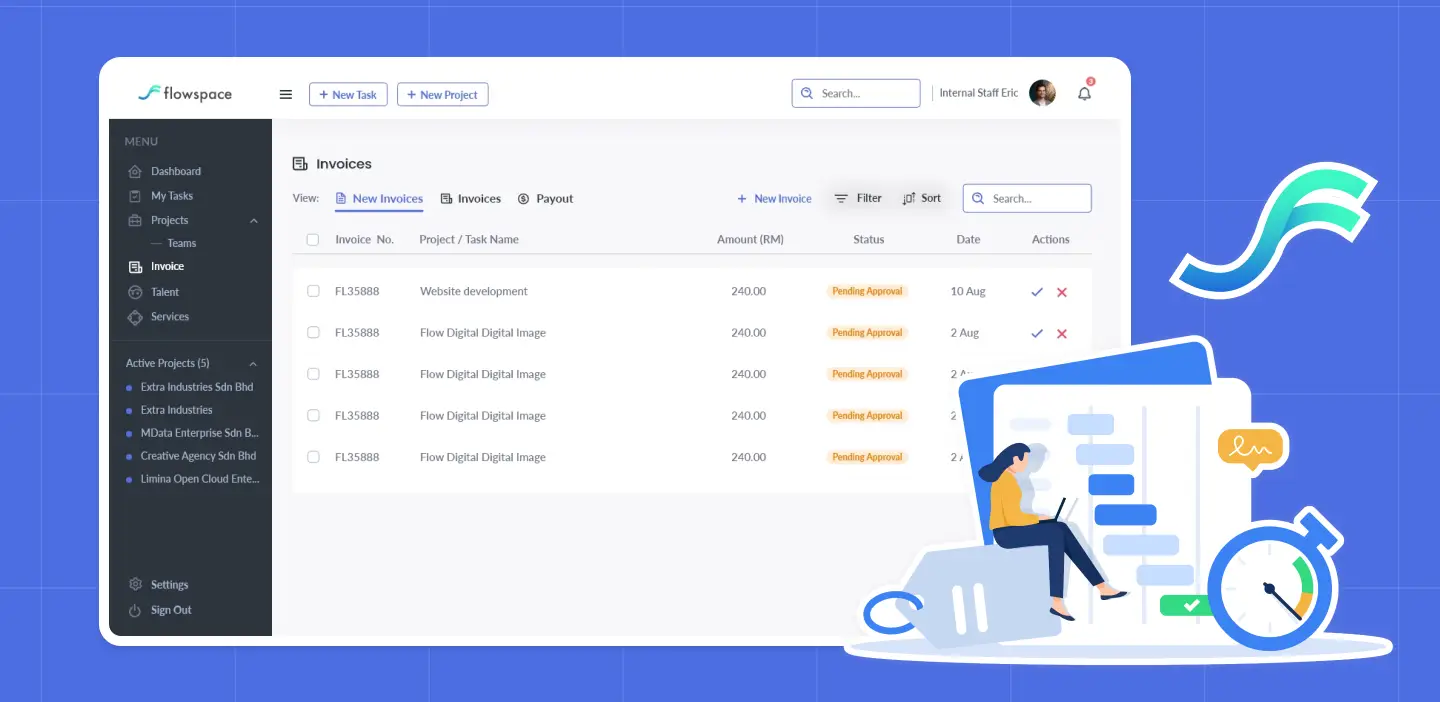
If you’re managing a growing team and looking for a smarter way to track performance, client relationships, and workflows, Flowhubr is a CRM and project management platform built for Malaysian businesses navigating exactly this transition.
When Hiring Still Makes More Sense
This article would be incomplete without saying this clearly: AI is not always the right answer.
There are roles where hiring a person isn’t just the better option, it’s the only viable one.
Roles that require human presence and judgment:
- Senior management and strategic decision-making
- Sales roles that depend on relationship equity and trust
- Client-facing consulting or advisory services
- Creative roles that require original thinking and cultural sensitivity
- Roles where accountability and legal responsibility matter
There are also real risks in over-relying on AI. Data privacy concerns are significant especially in industries like healthcare, legal, and finance where sensitive information is involved. AI systems can also fail at personalisation when the conversation moves beyond scripted scenarios, and a poor AI experience can damage your brand faster than a slow human response can.
The compliance landscape is also evolving. Malaysia’s Personal Data Protection Act (PDPA) imposes obligations on how data is collected, processed, and stored and businesses integrating AI systems need to ensure those systems are compliant.
AI is a tool that augments your workforce. It is not a workforce replacement.
Decision Framework: AI, Hiring, or Both?
Before making a decision, ask yourself these three questions:
1. Is the task repetitive or does it require creative judgment?
Repetitive, rules-based tasks (data entry, FAQ responses, appointment scheduling) are AI territory. Tasks requiring nuanced thinking, relationship management, or original output still need people.
2. What is the required scalability?
If volume fluctuates significantly or you’re expecting growth, AI scales without friction. A human team requires proportional headcount increases.
3. What is your budget constraint?
If cash flow is tight, AI typically has a faster payback period and lower ongoing cost. If you need senior-level expertise, hiring is unavoidable but consider whether AI can handle the routine work that supports that hire, so the high-value person focuses on high-value work.
A practical framework:
Scenario | Recommendation |
High-volume, repetitive tasks | Automate with AI |
Strategic, relationship-driven roles | Hire |
Growing team with operational burden | Hybrid: AI for operations, hire for leadership |
Early-stage SME with limited budget | Start with AI tools, hire selectively |
The Smartest Move Is Knowing When to Use Which
The question isn’t really AI or people. It’s about building the most effective operating model for where your business is right now and where it’s heading.
AI can dramatically reduce costs in the right contexts. For repetitive, scalable, and time-sensitive tasks, the financial case is clear. But the businesses that gain a lasting competitive edge aren’t the ones who replace their workforce with bots, they’re the ones who deploy AI to do the heavy lifting so their people can focus on what actually drives growth.
In Malaysia’s current business environment, where labour costs are rising and AI tools are more accessible than ever, the hybrid model isn’t just cost-effective. It’s the strategic default.
The earlier you adapt, the bigger the head start.
Ready to Reduce Costs with the Right AI Strategy?
If you’re evaluating how AI can fit into your current operations whether that’s automating customer support, streamlining internal workflows, or building a smarter sales process Flow Digital helps Malaysian businesses design and implement AI solutions that actually deliver ROI.
Looking to automate your business processes? Discover how AI-powered automation can reduce operational costs and improve efficiency across your team. Book a consultation with Flow Digital and let’s map out a strategy built around your actual numbers.
Frequently Asked Questions (FAQ)
01.What types of jobs can AI replace in Malaysian businesses?
AI can replace repetitive tasks like customer support, data entry, and scheduling. These roles are rule-based and easy to automate using AI tools. However, strategic and creative roles still require human employees.
02.How much does AI automation cost in Malaysia?
AI tools in Malaysia usually cost between RM100 and RM1,500 per month. Custom AI systems may require higher upfront costs but offer long-term savings. Overall, AI provides a scalable alternative to fixed salaries.
03.Is it better to invest in AI or hire employees?
It depends on the task. AI is ideal for repetitive work, while hiring is necessary for strategic and client-facing roles. Most businesses benefit from a hybrid approach combining both.
04.What are the hidden costs of hiring employees in Malaysia?
Hiring includes more than salary—there are EPF, SOCSO, training, and equipment costs. Turnover and productivity gaps also add to the total cost. This makes hiring more expensive than it appears.
05.Can AI improve productivity more than human employees?
AI improves productivity by working 24/7 with consistent output. It handles large volumes quickly and accurately. However, humans are still better at decision-making and complex tasks.
06.How do I decide if my business should use AI automation?
If your business has repetitive tasks, AI can reduce costs and save time. It’s especially useful for scaling operations without increasing headcount. Consulting an AI automation agency can help identify the right use cases.
07.Are there risks of using AI instead of hiring?
Yes, AI may struggle with complex or sensitive tasks. Poor implementation can affect customer experience and compliance. A balanced approach helps minimise these risks.
08.What is the best strategy: AI, hiring, or both?
A hybrid model is usually the best approach. Use AI for repetitive tasks and employees for strategic work. This maximises efficiency while maintaining business quality.