
Automation is no longer a concept reserved for large corporations with dedicated IT teams. Today, businesses of all sizes are rethinking how they operate from managing customer enquiries to processing invoices and automation is at the centre of that conversation.
But not all automation is created equal. The debate around AI workflow automation vs traditional automation has become one of the most important decisions business owners and operations managers face today. Understanding the difference between the two is not just a technical exercise. It directly affects how efficiently your business runs, how well you can scale, and how much it actually costs you over time.
In this article, we break down what each approach involves, how they compare across key dimensions, and how Malaysian businesses, particularly SMEs, can make the right choice based on their current situation.
What Is Traditional Automation?
Traditional automation, often referred to as rule-based automation, is built around fixed logic. You define a set of rules, the system follows them, and the output is predictable every time. There is no interpretation involved; the system does exactly what it is told, nothing more and nothing less.
Some of the most common examples include:
- Payroll systems that calculate salaries based on preset formulas and attendance records
- Basic email autoresponders that send a templated reply when a form is submitted
- Data entry scripts that move information from one spreadsheet to another based on matching fields
- Invoice generation tools that populate templates using customer data from a database
The biggest strength of traditional automation is its reliability. If the rules are correct, the output will be consistent. There is little room for error as long as the underlying logic holds. For businesses that have stable, repetitive workflows with little variation, this is genuinely valuable.
However, the limitations become apparent quickly. Traditional automation cannot handle exceptions. If something falls outside the defined rules, the system either fails or requires human intervention. Updating the logic requires manual reprogramming, which takes time and resources. And as business needs evolve, maintaining rule-based systems can become increasingly burdensome.
What Is AI Workflow Automation?
AI workflow automation takes a fundamentally different approach. Instead of following fixed rules, it uses machine learning, natural language processing (NLP), and intelligent decision-making to handle tasks that involve variability, complexity, or unstructured data.
Rather than being told exactly what to do in every scenario, an AI-powered system learns from data over time and adapts its behaviour accordingly. The more it runs, the better it gets.
Practical examples of AI workflow automation include:
- AI chatbots that understand customer queries in natural language and respond contextually, not just with scripted replies
- Intelligent document processing that reads and extracts information from invoices, contracts, or forms regardless of format
- Predictive analytics workflows that forecast demand, flag anomalies, or recommend actions based on historical patterns
- Automated sales funnel workflows that adjust follow-up sequences based on customer behaviour and intent signals
The key advantage here is the ability to improve without manual reprogramming. AI automation gets smarter over time, handles edge cases more gracefully, and can work with data types that rule-based systems cannot touch. According to McKinsey’s State of AI 2025 report, 88% of organisations now use AI in at least one business function, reflecting how rapidly this has shifted from experimental to operational.
Core Differences Between AI Workflow Automation and Traditional Automation
The distinction between AI workflow automation vs traditional automation is not just about technology. It is about how each approach handles real-world business complexity.
Here is a direct comparison across the dimensions that matter most:
Dimension | Traditional Automation | AI Workflow Automation |
Decision Logic | Rule-based, fixed | Data-driven, adaptive |
Flexibility | Low — requires manual updates for changes | High — adapts to new patterns automatically |
Handling Unstructured Data | Cannot process (emails, PDFs, voice) | Designed for unstructured inputs |
Scalability | Limited without significant rework | Scales with data and usage |
Accuracy Over Time | Static — only as good as the original rules | Improves through learning |
Cost Over Time | Low initial, rises with maintenance | Higher initial, lowers as ROI compounds |
Human Intervention Required | High — for exceptions and updates | Lower — handles exceptions independently |
Best For | Stable, repetitive, clearly defined tasks | Variable, complex, or data-heavy workflows |
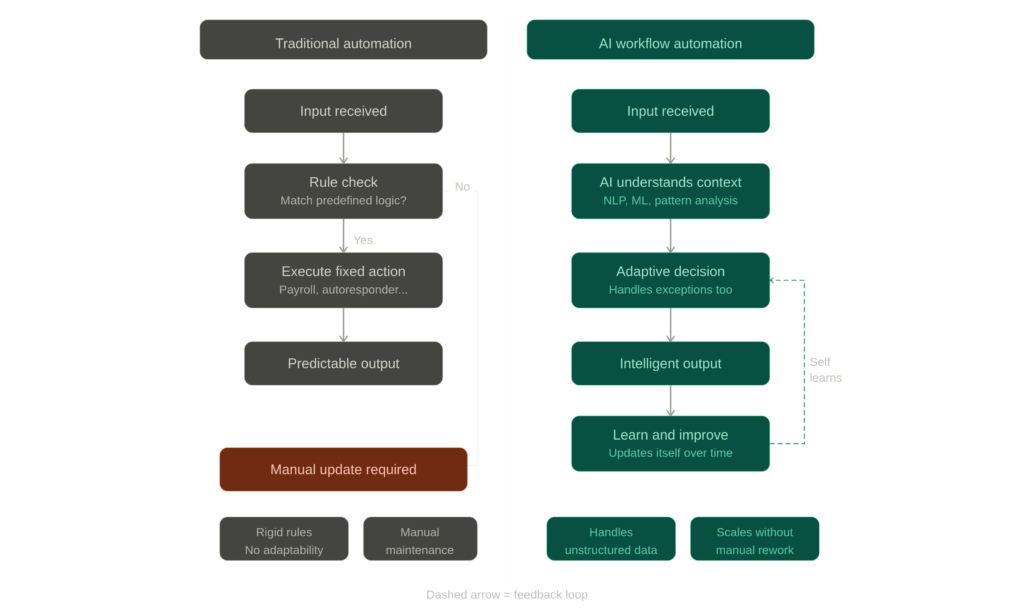
The fundamental shift is from static to adaptive. Traditional automation is a tool you configure once and maintain forever. AI workflow automation is a system that grows alongside your business.
Benefits of AI Workflow Automation Over Traditional Automation
The case for AI workflow automation becomes stronger as businesses deal with more complex operations and higher volumes of unstructured data. Here are the key advantages:
Intelligent decision-making without constant oversight. AI automation can handle multi-step processes that require contextual judgement something rule-based systems simply cannot do. This reduces the number of manual checkpoints required in day-to-day operations.
Reduced dependency on human intervention. When workflows involve exceptions or variability, traditional automation breaks down and requires a human to step in. AI systems can manage these cases autonomously, freeing your team to focus on higher-value work. Research cited by McKinsey found that workflow redesign through AI delivers the largest measurable impact on business earnings.
Better handling of unstructured data. Most real business data , emails, PDFs, customer messages, voice recordings is unstructured. Traditional automation cannot read it. AI can extract meaning, categorise it, and act on it in real time.
Continuous optimisation. AI systems do not stay static. They refine their outputs over time based on new data, which means your automation becomes more accurate and efficient the longer it runs.
Real-time insights built into the workflow. Many AI automation platforms generate actionable analytics as a byproduct of execution giving operations teams visibility they would otherwise need separate tools to obtain.
When Traditional Automation Still Makes Sense
It would be misleading to suggest that AI automation is the right fit for every situation. There are scenarios where traditional, rule-based automation remains the more practical and cost-effective choice.
Simple, stable, and highly repetitive tasks are still well-served by traditional automation. If you are generating the same invoice format for the same type of transaction every day, there is no meaningful benefit to introducing AI into that workflow. The logic is clear, the output is consistent, and the cost of maintaining a simple rule-based system is predictable.
Cost considerations for smaller businesses also matter. AI workflow automation typically requires a higher upfront investment in tools, integration, and configuration. For businesses with limited budgets or straightforward operational needs, traditional automation delivers sufficient value at a fraction of the cost. Under Malaysia’s 2026 Budget, Bank Negara Malaysia has allocated RM3.8 billion in SME loans to support digitalisation and automation transitions, but businesses should still evaluate the right type of automation before committing.
Legacy system integration is another consideration. Older infrastructure may not support the data flows required by AI platforms. In these cases, a lighter rule-based automation layer may be more practical while the organisation gradually upgrades its core systems.
The honest truth is that for many Malaysian SMEs, the journey starts with traditional automation — getting the basics right, building process discipline, and identifying where complexity genuinely demands a smarter solution.
Use Cases: Real-World Applications in Malaysian Businesses
The way automation plays out in practice varies significantly between AI-driven and traditional approaches. Here are real-world scenarios relevant to businesses operating in Malaysia.
Where AI workflow automation is making an impact:
- Customer support automation — AI chatbots that handle enquiries in Bahasa Malaysia and English, managing FAQs, appointment booking, and complaint routing without human involvement
- Sales funnel automation — Intelligent workflows that score leads, personalise follow-up messages based on browsing behaviour, and route high-intent prospects to sales teams
- HR onboarding workflows — AI systems that collect documents, check completeness, send reminders, and integrate data into HR platforms without requiring manual input
- Intelligent document processing — Reading and extracting data from supplier invoices or delivery orders regardless of format variations
Where traditional automation still does the job:
- Payroll processing — Fixed-formula calculations applied consistently every month
- Invoice generation — Templated billing triggered by completed orders or contract milestones
- Basic report scheduling — Automated export and delivery of weekly reports to stakeholders
According to data from Visa’s SME Landscape Study, Malaysian SMEs account for 97% of all businesses and provide 48% of employment. As rising operational costs and labour expenses remain top challenges, automation of both types has become a critical lever for maintaining competitiveness.
For businesses looking to manage customer relationships and automate follow-up processes alongside their automation stack, platforms like Flowhubr offer integrated CRM capabilities that complement both rule-based and AI-driven workflows.
How to Choose Between AI Workflow Automation and Traditional Automation
Choosing the right approach comes down to understanding your specific situation honestly, rather than chasing the most advanced solution available.
Here is a practical decision framework:
Consider traditional automation if:
- Your processes are stable and rarely change
- Your data is structured and well-defined
- Your budget is limited and ROI timelines need to be short
- You are just starting your automation journey and need quick wins
Consider AI workflow automation if:
- Your workflows involve variability, exceptions, or unstructured data
- You need automation that scales without constant maintenance
- You have sufficient data to train and improve the system over time
- You are looking for long-term efficiency gains and competitive differentiation
A hybrid approach is often the best starting point. Many mature businesses run traditional automation for stable, well-defined tasks while deploying AI automation selectively for complex or high-volume processes that require adaptability. This staged approach keeps costs manageable while allowing the business to build confidence with AI systems gradually.
According to MDEC’s Business Digitalisation Initiative, Malaysian businesses can access advisory services and financial assistance to assess their digital maturity level and identify the right tools for their stage of growth. Malaysia’s digital transformation market is projected to grow from USD 12.67 billion in 2026 to USD 29.74 billion by 2031, with SMEs recording the fastest growth rate — making now the right time to evaluate where automation fits in your strategy.
The key questions to ask before deciding:
- How often does this process change?
- Does the data involved follow a consistent structure?
- What is the cost of exceptions and errors if the system fails?
- Do we have the technical capacity to maintain rule-based logic over time?
- What is the realistic ROI horizon for each approach given our budget?
Conclusion: Both Have a Place, but the Future Is Intelligent
The comparison between AI workflow automation vs traditional automation is not about which is better in absolute terms. It is about which is right for your business, your workflows, and your stage of growth.
Traditional automation remains a reliable foundation for stable, structured processes. It is predictable, cost-efficient for simple tasks, and easy to maintain when the underlying logic does not change frequently.
AI workflow automation, on the other hand, is the direction every growing business needs to move toward. Its ability to handle complexity, learn from data, and reduce human dependency over time makes it the more sustainable choice for businesses looking to scale without proportionally scaling their headcount or operational overhead.
The most effective businesses in 2026 are not choosing one over the other. They are being strategic about where each type of automation delivers the most value, and building a roadmap that evolves as their operations become more sophisticated.
If you are still running manual processes for tasks that automation could handle, the gap between your efficiency and your competitors’ is growing every month.
Ready to Explore How Automation Can Work for Your Business?
At Flow Digital, we help Malaysian businesses assess their current workflows, identify the right type of automation for each process, and implement solutions that deliver measurable results.
Whether you are just starting to explore automation or looking to move beyond basic rule-based systems toward AI-powered workflows, we can help you build a strategy that fits your operations, your budget, and your goals.
If you want to understand where your business stands today and what intelligent automation could look like for your specific workflows, reach out for a consultation. There is no obligation — just a clearer picture of what is possible.
Connect with Flow Digital and take the first step toward smarter operations.
Frequently Asked Questions (FAQ)
01.What is the main difference between AI workflow automation and traditional automation?
Traditional automation follows fixed, predefined rules to execute repetitive tasks. AI workflow automation uses machine learning and data-driven logic to handle variable, complex processes and improve over time without manual reprogramming.
02. Is AI workflow automation suitable for small businesses in Malaysia?
Yes, but the fit depends on the complexity of your workflows. Many small businesses start with traditional automation for basic tasks and adopt AI automation selectively as their operations scale. Government grants through MDEC and BSN can also help offset implementation costs.
03.What kinds of tasks are best suited for traditional automation?
Payroll processing, invoice generation, scheduled reporting, and basic email responses are well-suited for traditional automation. These are stable, structured tasks with consistent inputs and outputs.
04.What can AI workflow automation do that traditional automation cannot?
AI automation can process unstructured data such as emails, documents, and customer messages; handle exceptions and edge cases autonomously; learn from historical data to improve accuracy; and make contextual decisions without manual rule updates.
05.How much does AI workflow automation cost compared to traditional automation?
AI workflow automation typically requires a higher upfront investment in tools and configuration. However, the long-term cost per process tends to decrease as the system scales and improves. Traditional automation is cheaper initially but often requires more ongoing maintenance as business logic evolves.
06.Can a business use both types of automation at the same time?
Yes. A hybrid approach is often the most practical strategy, using traditional automation for stable, well-defined tasks and AI automation for complex or variable processes that benefit from intelligent decision-making.
07.How do I know if my business is ready for AI workflow automation?
If you have repetitive processes that involve unstructured data, frequent exceptions, or require contextual judgement, your business is likely ready to benefit from AI automation. Consulting with a specialist can help you identify the right starting point based on your current workflows and data availability.